"A REALLY INTELLIGENT INTERVIEWER." -- Lance Henriksen "QUITE SIMPLY, THE BEST HORROR-THEMED BLOG ON THE NET." -- Joe Maddrey,Nightmares in Red White & Blue
In the early days of The Vault of Horror, Jaume Balaguero and Paco Plaza's [Rec] was the one of the very first new horror films I passionately championed. I wanted to get the word out about this fantastic Spanish zombie film that, unfortunately, was not known to many American fans. It turned out I wasn't the only one, as lots of other writers in the horror blogosphere with which I was just becoming acquainted were also raving about it.
In my opinion, the original [Rec] was the most downright terrifying horror film of the previous decade. It was the kind of a movie that grabs the neckhairs of even a hardened fright film watcher like myself and says: "Be afraid." So it was with great relish that I latched on to the opportunity to experience [Rec] 2, Balaguero and Plaza's continuation of their tale of undead outbreak. And I'm excited to say that it was an intense flick that's almost as much fun as the original, and in some ways, even more interesting.
[Rec] 2 picks up the action right where we left off at the end of the first one--kind of like a Rocky movie, except with dead people instead of boxers. We're right back on the scene of the quarantined apartment building, as a SWAT team and a special government agent infiltrate the structure to figure out just what the hell is going on inside. Matters are further complicated by a group of overly curious teens who sneak into the building as well.
The story is told, once again, in cinema verite style, with all the action depicted via "real life" video recordings. It's the same "found footage" approach taken by cinematographer Pablo Rosso in the original, except this time the film makers kind of riff on that style, giving us several different points of view from a few different camera sources, such as the cams carried by the SWAT members, the camera inevitably carried by one of the teens, etc. It's all edited together to create a real feeling of development from the original; Balaguero and Plaza are consciously exploring and expanding the visual "gimmick" they introduced the first time out.
This time, however--and this felt like an intentional decision--the action is less chaotic, and more coherent. One of the criticisms of the original (thought not by me) was that it was almost too realistic, with a constant stream of panicked yelling and screaming, and stretches of action so muddled by movement and noise as to be overly disorienting. This time, the whole thing feels a bit more dramatized, more traditional in presentation, and I don't mean that necessarily as a negative. Rather, I found it to be a change of pace and just one of the things that make this movie anything but the tired aping of the original that it easily could've been.
Another area in which there is bold and fascinating development going on is the direction taken by Balaguero, Plaza and their scripting collaborator Manu Diex in the actual narrative. Whereas the first time out, we got a straightforward modern, infection-style zombie film, with only some hints at the end of the supernatural, this time things go full-tilt into the realm of the occult. This might put off some who appreciated the more "grounded in reality" approach of the original (whatever that may mean in a movie about the living dead), but I found this to be the most rewarding development of all.
[Spoilerish stuff ahead] What we wind up with is sort of a cross between 28 Days Later and The Exorcist, with our undead turning out to be not quite zombies after all, but closer in species to Sam Raimi's Deadites, or perhaps a whole bunch of very angry Regan MacNeils, if you prefer. It's demonic possession that spreads organically, like a contagion. I was totally enthralled by this concept, and pleasantly surprised that the story went in this direction. Science and religion are blended into the kind of hybrid that takes a little getting used to, but is nevertheless original, engaging stuff.
My biggest gripe would be the one aspect in which this sequel does slavishly attempt to follow its predecessor, which is in the presentation of the monstrous Madeiros girl who is the source of the infection. You can feel the movie building up once again to the big reveal, just as it did the first time, and you get the sense that they were shamelessly trying to reproduce the sheer terror and adrenaline rush of that infamous climactic scene in the original in which main character Angela Vidal first encounters the possessed girl.
Here, the scene feels forced, tacked on, and worst of all, is built on some heavy-handed pseudo-religious/scientific nonsense I just didn't buy, which insisted that the girl could not be seen in the light, since she was shunned by God or something like that. As a result, the only way to see her, conveniently enough, is via the night-vision camera used to see her in the original. Furthermore, this doesn't explain why the creature was unable to interact with them earlier in the film (just because they couldn't see her?) Anyway, not to belabor the point, this is a relatively small problem in an otherwise very enjoyable horror film.
[Rec] 2 also ends with a little twist and some flashback footage that both lets us in on what exactly happened to Angela when she got pulled down that air duct, and also sets us up for a [Rec] 3 which looks like it will go in a far more large-scale, ambitious direction than the previous two. All in all, it's a more traditional horror film than its predecessor, with some intriguing thematic and narrative developments, even if the re-treading of somewhat familiar territory unavoidably ensures that it's not quite the white-knuckle roller coaster of pulse-pounding terror that the original was.
One of the key elements established by the modern horror film is that you don't necessarily need monsters to generate terror. Rather, very often, as the old cliche goes, the worst monsters of all are ourselves. In other words, the real-life evils of the human mind can be far more terrifying than any make-believe supernatural entity. Perhaps that's why the serial killer sub-genre has proliferated so much in recent decades.
This week in The Lucky 13, both here and at Brutal as Hell, we pick our very favorite serial killer movies--and I think you're going to find some of the most eclectic choices selected thus far in our little ongoing group project. For example, on our side here at the VoH, who would've thought that this particular sub-genre would feature not one, but two Vincent Price movies? And oh yeah, that Lecter guy shows up, too...
B-Sol on Theater of Blood
Just when I thought it wasn't possible for me to love Vincent Price more than I already did, along came this absolute gem of a movie into my world. As an English major with a concentration in Shakespeare, and an unabashed horror fanatic, this film was literally tailor-made for me. The film revolves around a series of brilliant murder set-pieces. And Price is utterly remarkable throughout each, playing the part of the vengeful Lionheart with such gusto that one can't help but be completely enraptured by him. My particular favorite is the fencing scene, in which Price reenacts the duel from Romeo & Juliet, his face a gleaming mask of self-satisfied, evil glee as he spouts purple prose to no end.
Theater of Blood is an exceptionally dark and vicious comedy. While unceasingly funny, it is also surprisingly bloody, featuring fairly graphic scenes of organ removal, electrocution, beheading and more. In fact, I'm hard-pressed to think of a gorier Vincent Price flick at the moment. To watch Price chew up the scenery, letting Shakespearean soliloquies fly left and right, it's almost impossible to describe my elation. You can tell he's really enjoying himself here, and that carries across to the viewer. He also gets the chance to appear in a series of fairly ludicrous disguises, adding another level of delicious camp to his performance.
Theater of Blood proves beyond a shadow of a doubt that Vincent Price was a national treasure, and it is truly sad that he is no longer with us. Yet with thoroughly enjoyable films like this left behind, it's assured that he will never, ever be forgotten.
On my list of top movie villains of all-time, Hannibal Lecter occupies the second spot (number one, with a bullet, is Darth Vader). He has killed as many as 30 people. He manipulates. He terrorizes. He eats their corpses. Hannibal Lecter is an unstoppable killing machine, a brilliant mind and the face of unblinking, primal evil. With only 15 minutes of screen time and uncanny chemistry with Jodie Foster in The Silence of the Lambs, Lecter became a household name and a pop-cultural icon of horror. Any character that evil and despicable that can win your heart, even after he chews a cop's face off, is a very special thing.
The Silence of the Lambs is an anomaly in horror. Most horror flicks tend to blow out the legend of the American serial killer to cartoony proportions. The killers are these menacing, raving lunatics who live to kill and spend all their time murdering, plotting and terrorizing their victims, but The Silence of the Lambs approached horror and serial murder with a true-crime novel sensibility. It reels in the natural Hollywood tendency to go balls to the wall for scares and instead opts for a slow burner that creeps up on you. In this context, Lecter is a bit excessive but he's also not the star of the show. Agent Clarice Starling is searching for Buffalo Bill, a composite of Ed Gein and Ted Bundy, played to maximum creep-factor by Ted freakin' Levine. Levine in his role as the gender-confused murderer gave us the sort of scenes that stay with people forever. Since 1991, "I'd fuck me" and "PUT THE FUCKING LOTION IN THE BASKET!!!" have achieved the sort of quotability afforded only The Simpsons in the past. That's not to discount the amazing lines given to Anthony Hopkins. The bite mask and fava beans still resonate to this day in our culture.
Somehow, director Johnathan Demme managed to crawl out of his off-beat hole, previously having directed bizarro comedies, The Talking Heads tourfilm and sleazy women in prison flicks, to craft one of the most morbid, oppressive horror films of the 20th century. This was the '90s answer to Hitchcock's Psycho, and a worthy successor at that. The Silence of the Lambs came to define the very essence of the police procedural movie and set the bar high for competing pictures. All the pieces to the puzzle fit snugly, an amazing cast meshed perfectly with Ted Tally's tight script, leaving us with one of the most effectively unsettling horror movies of all time. If you need further proof that Roger Corman is one of the most important figures in American filmmaking, this is it. Demme is yet another extremely talented filmmaker to emerge from Corman's class. Corman even has a cameo as an FBI director (George Romero also pops up quickly toward the end). Now if you'll excuse me, I must return to my dinner. I'm having liver with fava beans and a nice chianti.
Thirty-three years before a pessimistic bloke named Jigsaw made his way on to the horror scene with face traps and other insidious devices, Vincent Price was busy exacting his own unique brand of justice upon those whom his character viewed as immoral. The said character went by the name of Dr. Anton Phibes, a musical genius who studied extensively in theology and who spent his spare time viciously murdering people. One does not need a brooding atmosphere of dread and bleak performances to create a solid serial killer film. If anything, The Abominable Dr. Phibes shows that a movie can showcase the mad workings of a systematic assassin and have a fun time while doing it.
This is Vincent Price at one of his finest hours, in the type of role that those who know him could instantly picture him in upon hearing his name. Here he plays a tragic anti-hero seeking vengeance against a medical team that he believes was responsible for the premature death of his beloved wife. He carries this out by executing his targets in the same fashion as the Biblical Ten Plagues of Egypt. Bloodthirsty bats and vermin, impalement by unicorn statuettes, and achingly slow death by blood draining and hypothermia all play out to the pounding blasts of organ and sweet melodies of violin. Even under a restrictive cast of his own likeness, Price manages to display a full range of powerful emotions solely through his ever-staring eyes and body gestures. It is a role that proudly displays Price’s great strength and versatility as a master thespian and King of Terror.
The film is also immensely impressive from a technical standpoint as well. Director Robert Fuest (who helmed many episodes of The Avengers) pulls off numerous intricate and visually compelling shots with his camera. The cinematography lends a whole other layer of vitality to the film, each color seemingly bursting from the screen and painting all the gory proceedings in a beautiful and lavish manner. The art deco sets are another highlight to watch out for, Joseph Cotten’s home and Phibes’ diabolical lair prime examples of this supreme craftsmanship. The humor in the film is spot-on, each actor delivering their lines in a perfectly snappy fashion. The movie has an air of the theater, each bit part and minor character fully realized and played to the hilt for the biggest laughs. The feeling of eccentricity compliments all the ghoulish goings-on in a way that has to be seen to be appreciated.
The Abominable Dr. Phibes should be in the “must watch” list of every horror fan, whether they be budding enthusiasts or seasoned veterans of the genre. It is a movie that will remind you of what fun it is to be in love with horror. If you’ve already had the insidious pleasure of viewing this film, then you know full-well of the feel-goodness this brings on in its audience. If you haven’t though, be sure to amend your terrible sins as quickly as you can and do just as the doctor prescribes.
* * * * * * * * * *
Head over to Brutal as Hell to see what Marc Patterson and his crew have come up with. And if you're interested in taking part in the future, just give Marc or myself a holler.
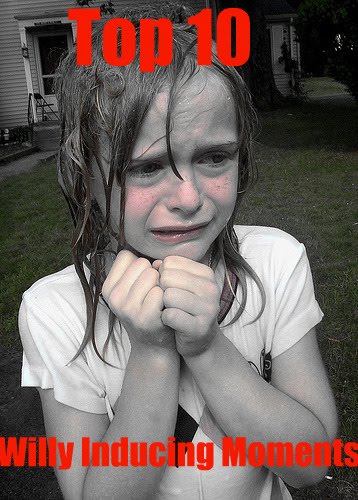
Some two weeks ago, Andre Dumas of The Horror Digest set the horror blogosphere afire with her "Top 10 Willy Inducing Moments," a catalog of the specific moments in horror which freak her out the most. Since then, every blogger and their parent or legal guardian has been chipping in their two cents, offering their own list of moments that give them the willies.
I happened to be on a much-deserved vacation when the whole thing kicked off, and it's taken me a little while to catch up. But now I'm back and finally ready to take my crack at this whole willy thing. It may not be Tuesday, but what the hell--here are my Top 10 Willy Inducing Moments...
10. Inside (2007) - The Milk of Inhuman Kindness This frakked-up little filmic French pastry is chock full of psyche-scarring moments, but for me the one that takes the cake is that final shot, which I suppose I shouldn't "spoil" for all you crybabies. Those who've seen it know the shot I mean--it involves a rocking chair and is about as twisted as it gets.
9. Invasion of the Body Snatchers (1956) - What the Fork... This movie really gets under your skin in general, and the first time I saw it as a kid it really messed me up. The whole idea of people transforming all around you and not knowing who to trust, really freaked me out. But I'll never forget the scene in which Kevin McCarthy discovers that opening pod, and stabs it with the pitchfork. The sight of the human face breaking apart amidst that sudsy pod gunk is the stuff of nightmares.
8. Nosferatu (1922) - Rising to the Occasion Here's one Andre picked herself, and I couldn't agree more. In one of horror's most emulated moments, the terrifying Count Orlock rises stiff as a board from his coffin in the hold of the Demeter, as witnessed by the soon-to-be-fish-food first mate. Max Schreck is at his most preternatural here, levitating 90 degrees and stretching out his arm, the very embodiment of death amongst the living.
7. Dracula (1931) - Laugh It Up, Nutball Yet another Stoker adaptation, and yet another scene in the hold of the Demeter. Except this time, the source is no vampire, but rather his insane thrall Renfield, driven mad by the Count's influence. As the authorities peer down into the trap door to see Dwight Frye staring back up at them, that Joker-like grin beaming as he lets out his infamous leering laugh, I feel the hairs literally stand up on the back of my neck.
6. Zombi 2 (1979) - Shallowest Graveyard Ever... Zombies will always gnaw at the very center of what really gets to me when it comes to horror movies, and nothing embodies that dread factor more for me than the scene in the Spanish conquistador cemetery. Our heroes are finally enjoying a moment of peace, when all of a sudden, the corpses underneath them claw their way through the apparent four inches of dirt under which they were buried. It's grim, it's relentless, and it's pure Fulci. Chills...
5. Salem's Lot (1979) - Let the Wrong One In I've said it before, and I'll say it again: Creepy kids will always be scary as hell. Something about that perversion of innocence. And when the vampire boy appears at his brother's window, floating outside in the mist as he asks to be let in, it really gets at something primal. This one also feels like something out of a nightmare, especially from the point of view of a child.
4. The Shining (1980) - Lovely Party, My Ass For a guy who wasn't really known as a horror director, Stanley Kubrick sure knew how to creep people out. Virtually all of his films have those really messed up moments that play with your head and stay with you for a long time. This is especially true in his all-out horror extravaganza The Shining, in which we inexplicably witness some guy in a bear suit perpetrating an act on another guy which I would imagine can't be easy to perform while wearing a bear suit. The ultimate bizarre, "did I just see that?" movie moment.
3. [REC] (2007) - Hide and Freak I'd have to call [REC] the downright scariest movie of the last decade, and it builds up to this nerve-frying finale, in which Angela and her cameraman finally discover the apartment building's hidden secret. With the lights out, as Angela desperately feels her way around, we get a glimpse through the camera's night vision of what's in the room with her, and it ain't good. Truly a white-knuckle moment.
2. The Haunting (1963) - I Hear You Knocking... Robert Wise's atmospheric adaptation of the Shirley Jackson novel is probably the film that gets the most out of showing the least. While Eleanor and Theodora are sharing a bedroom, they come under siege from some supernatural force that begins insistently banging on the walls and door, even appearing to distend the wall itself at one point. It's a harrowing scene, made even more so by Julie Harris' terrified performance.
1. The Changeling (1980) - Throwing Out the Baby with the Bath Water The one that takes the cake for me. I can honestly say that this moment caused me so much trauma that it literally had an effect on my life for years. It's the scene in which George C. Scott enters his bathroom to see the tub filling with water, then looks inside and sees a little boy submerged underneath, gasping for air--a ghost recreating the manner in which it was killed. After seeing this as a little kid (detecting a pattern here?) I actually developed a fear of baths, always afraid I'd see the little boy under the water. In fact, the fear even extended to toilet bowls for a while--now that made for some troubling experiences, I can tell you that. Thankfully, I'm over it now. More or less.
Let's get this out of the way right off the bat, because I've been sitting on this and mulling it over for quite a while. As many of you know, and have probably seen elsewhere, the first official trailer for Let Me In, Matt Reeves adaptation of John Ajvide Lindqvist's Swedish novel Let the Right One In, was unveiled earlier this month. For those who haven't seen it yet, here it is:
To merely refer to it as an adaptation of the novel is to be a bit coy however, as we all know that the book was, only two years ago, adapted into a superb Swedish film by Tomas Alfredson. It was a film which many called the greatest vampire movie of all time, and I would personally rank among the best films I've seen in recent years, perhaps second only to There Will Be Blood as the best film of the '00s. It was powerful, it was moving, it was expertly acted and directed, with an unforgettable score and a timeless quality few contemporary films maintain.
And so, to a certain extent, we must admit that Reeves' Let Me In is just another in a long line of English-language horror remakes put together in the wake of a successful foreign film, much as we saw with Quarantine ([REC]), The Ring (Ringu) and many others. Yes, Reeves claims to be going back to the original source material, but you and I both know that this movie would not have been made were it not for Alfredson's film. So what do we make of it?
Granted, my knee-jerk reaction is to lament the inanity of the American movie machine, which seems to have lost all faith in American audiences consuming anything that isn't completely spoon-fed to them. I mean, why not simply dub these successful foreign films into English if you're so worried about Americans not wanting to read subtitles? Did they remake The Good, The Bad and the Ugly in 1968 with all American actors? I guess the closest thing I can think of to this modern phenomenon is the way the original Gojira was ruined with new footage to appeal to American audiences in 1956. Is that really the model to be emulating?
But on the other hand, everything I've seen regarding this American version has been impressive. Chloe Moretz of Kick-Ass seems pitch-perfect as Eli (or Abby if they insist) and this Kodi Smit-McPhee kid they got to play Oskar (Owen...sigh, what's wrong with Oskar??) also seems up to the task. Checking out the trailer also gives me even more hope that this will be a good movie--the look is right, it seems to be faithful to the material, and the relationship between the two leads feels right. Also, love that Morse code ending. This does not seem (too much) like a watered-down Americanization. Some of the calm beauty of the Swedish film seems to be replaced with the typically dire, potboiler tone most Americans are more used to, but that could very well be the way the trailer is edited. And of course, Eli has been unequivocally confirmed as a girl, which was to be expected.
Still, one has to ask, why bother? If the reason is to truly go back to the book and do something different, they don't seem to going about it that way at all. Watching that trailer felt very much like watching Alfredson's film, down to specific moments and shots being mimicked (much like Quarantine did.) Sure, they're apparently exploring some stuff from the novel that wasn't in the other movie, such as the ultra-bizarre Hakan subplot, but quite frankly, from what I've seen, that doesn't seem to be playing much of a major part. Rather, it seems mainly to be aping Alfredson's work. And if that's the case, no matter how great it is, I'm still going to be walking away scratching my head wondering why it was even attempted. Or more accurately, I'll be shaking my head, knowing precisely the only reason it was attempted: another easy payday.
I'm so on the fence about this project, it's not even funny. Let the Right One In is a movie that's very close to my heart, and sure, I know the old saying, no matter what they do with it, the original still exists for me to enjoy. I just can't decide whether I'm happy about this new version or not. It does seem intriguing and well-made, I just hope that Reeves and company live up to their promise and give us something fresh and new--the novel is fertile enough ground to allow that--rather than just another spoon-fed American remake.
* * * * * * * * * *
REMINDER: For those who feel they missed out on the greatness that was Kevin Geeks Out!, I encourage you to get down to 92YTribeca in Manhattan this Friday night for the encore presentation of Mr. Maher's most acclaimed shlockfest of them all: Kevin Geeks Out About Sharks! I attended the initial presentation, and I can tell you it's a night you will carry with you till you sleep in Davey Jones' locker. Shark cupcakes will be provided for all, plus the first 10 people to arrive get a copy of the sold-out comic book Grizzly Shark and Sea Bear!
Kevin Geeks Out! returns for one night only, so don't miss out, dweebs! Get the ticket info and stuff at Kevin's blog.
Having already covered vampires as part of the The Lucky 13, this week here in the Vault--and over at Brutal as Hell--we turn our attentions to that other tried-and-true monster of horror cinema, the lycanthrope. Another creature of ancient folklore, the werewolf has existed in our shared consciousness long before movies ever existed, yet it's transitioned nicely onto the silver screen, becoming the source of many of the genre's finest efforts.
While it's true that werewolf films are fewer and farther between than vampire films, there are still quite a few gems to be found. In fact, given the lesser amount, one could argue that there are more high-quality werewolf flicks out there "per capita" than those of their bloodsucking brethren. And so, in our eighth installment of The Lucky 13, we select our all-time favorites...
B-Sol on Werewolf of London
The year is 1935, and Universal, the studio which has made a name for itself producing films about Dracula, Frankenstein, The Invisible Man and The Mummy, has turned its attentions at last to the legend of the werewolf. The movie is Werewolf of London, and for some connoisseurs of vintage horror (including this one,) it remains the high watermark of lycanthrope cinema.
Henry Hull stars as Dr. Glendon, and English botanist who falls under the curse of the werewolf after being bitten on an expedition in the Himalayas. The vast bulk of cinema's take on the werewolf legend is already established in this one film: the transmission through biting, the transformation under the full moon, the beast's desire to destroy that which its human half loves most. The makeup created by Jack Pierce is striking, and Hull's humanoid, intelligent portrayal of the creature is quite unique, giving us one of the only talking werewolves of the silver screen. The film also puts the transformation scene front and center, a tradition that would continue throughout the history of the sub-genre. Werewolf of London remains one of the most influential, and yet also one of the most underrated horror films of the Universal canon.
For whatever reason, in its own day, Werewolf of London did not resonate with audiences to the same degree that previous Universal efforts had. But for my money, it's superior to the much better-known Lon Chaney Jr. film The Wolfman, which came along six years later. This was Universal's first crack at lycanthropy. Excellent Pierce makeup and a fine performance from Hull certify this one as required viewing for anyone who thinks werewolf flicks begin and end with AWIL.
Dog Soldiers is the kind of movie that surprises you. At first glance, you immediately know from the DVD cover that it's going to be a werewolf movie, but then about five minutes in, you have to wonder if you've stumbled upon some random war movie by mistake. A group of soldiers are on a training mission in the Scottish highlands, which in itself is rather creepy. The woods are steeped in thick atmosphere, and you can sense something bad is about to happen.
What you don't expect, however, is the level of tension that the film unloads after the men come across what is apparently the only survivor of some sort of ravaging attack on a special ops unit. They take the remaining fallen soldier with them and without warning are overwhelmed and pursued by unseen predators. A thrilling chase ensues and the squaddies are luckily picked up by a woman traveling alone on a sparsely populated road. She takes them to a nearby farmhouse, where they regroup and try to come to terms with the realization that the creatures hunting them are, in fact, huge carnivorous wolves. Werewolves. And they're hungry.
By and far, Dog Soldiers is a film that lives and dies by the atmosphere it has created. The dark, foreboding woods, being stranded with no recourse in a seemingly abandoned farmhouse, and of course there's this whole man-eating predator thing going on as well. It's a quick paced, well-acted, unexpected romp into the world of werewolves. The action doesn't stop once, the wolves are hulking, brutal examples of lycanthropes, and the gore.... there's a considerable amount, and combined with a moment or two of literal gut-ripping nastiness, it makes for a thoroughly enjoyable film. Tension abounds, and I was on the edge of my seat for most of the time. It's only fitting that director Neil Marshall's next film was also one of my favorites, The Descent. Face it, the man knows how to scare an audience.
I can count on one hand the really good werewolf movies I've seen, and Dog Soldiers has to sit very high on that list. From start to finish, it's a rock and roll kind of horror movie, amping up the action and shock content at every turn, and giving us a reason to believe the werewolf sub-genre didn't take a silver bullet after all.
I have an unconditional love for werewolves. From the earliest bipedals slinking through towering castles to the computer-generated hell hounds that currently rip and rend flesh in modern cinema, shape-shifters hold the power to entrance me with their hoary adventures. So it goes without saying that this week of The Lucky 13 came as somewhat of a challenge for me. No matter what film I chose, I felt there was a legion of other lycanthropic pictures that I was betraying my love for. After much deliberation and plenty cloves of wolfsbane, I was able to narrow my decision down to An American Werewolf in London. Even as my lupine heart ached to include other countless classics, a re-viewing of John Landis’ film proved to me that this was the one to go with.
What brings me to this conclusion, you ask? I think it’s the fact that AWIL remains in my mind as probably one of the most well-constructed horror films I’ve ever seen. It is a smooth viewing experience from start to finish, the quietest and most intimate of moments capturing your attention as much as the werewolf mayhem takes hold of your imagination. Landis’ hand at writing and direction creates a film that is pure cinematic magic. The suspense never deadens; he throws us right into the mix with the foreboding visit to The Slaughtered Lamb, and the anxiety never lets up as it leads to the bloody confrontation on the moors. And after that, we don’t see so much as wolf saliva till the hour mark. The entire time we’re wringing our hands, wondering what’s going to happen to David Naughton on the night of the full moon. Even when the tension is released momentarily with the reveal of the monster, we’re in a constant state of anticipation as to when the beast will strike next all the way up to the thrilling climax.
One of the most important factors in any werewolf story is having a palpable sense of sympathy for the tragic hero. With David Naughton as the leading man, the audience is guaranteed to fall in love with his likable personality. Even as David senses the impending danger of his curse, he cracks jokes and mugs his way through his troubles in a completely endearing manner. He plays a down-to-earth, easy-going fella who’s just trying to deal with this tremendous weight on his shoulders. He never loses his grip on humor and his constant jabs at the rotting remains of his friend Jack seem like what any one of us would do in his situation. The end of his painful journey can’t help but sadden us and touch us, bringing the characterization of his afflicted hero full circle.
This film is what kick started the werewolf renaissance in the '80s, no doubt due to Rick Baker’s innovative and game-changing makeup design. The man worked with the touch of a twisted artisan and created one of the most iconic and memorable transformations/monsters Hollywood has ever seen. For the first time we were explicitly shown just how damn painful it was to morph into a full-grown wolf. The twisting and snapping of David’s ligaments as his body stretches and hair pierces his flesh created a stark, clear picture of the agony of lycanthropy. Baker’s full wolf monster is impressive as well, the bloodsoaked jaws and hellfire eyes imbued with genuine rage and hunger as it rampages through Piccadilly Circus. Baker’s effects are elevated above and beyond the standard gruesome fare and almost become high art in their genius.
An American Werewolf in London really is one of the genre’s highlights for a reason. Its brilliant blend of terror and comedy, dynamite acting, spectacular makeup and powerful story brew into an intoxicating mix that’ll keep your claws glued to the screen. Seek this film out, appreciate it, and just be thankful that the horror community has been given such a gift as this. It’s enough to make you want to let out a hearty howl and run through the moon-streaked wood.
* * * * * * * * * *
Head over to Brutal as Hell to see what Marc Patterson and his crew have come up with. And if you're interested in taking part in the future, just give Marc or myself a holler.
I'm proud to announce that the upcoming modern-day exploitation flick known as Ratline--executive-produced and co-starring longtime Friend of the Vault and Vault contributor Jessie "Nos" Seitz of Gothic Beauty magazine--will soon be getting a bit of sneak preview at FEARnet.com. Beginning Monday, July 12, the web component of the on-demand horror service will be showing an entire scene from the movie, currently in post-production in anticipation of a release later this year.
Ratline tells the story of an ex-Nazi occultist who found a way to escape capture and survive the decades by paranormally extending his youth, taking refuge in a small Midwestern American town. There he crosses paths with a girl on the lam from cops due to a drug-money heist gone bloodily wrong. Unfortunately, she also gets mixed up in his despicable plot to return to his SS work and unleash supernatural havoc on the world.
The newest production of Wicked Pixel Cinema, the film is directed by Eric Stanze, previously known for Scrapbook, which was named 2001's Best Independent Film of the Year by Rue Morgue magazine. You can find out more about Ratline at:
I think this is probably a somewhat intimidating sub-genre, which accounts for the smaller amount of contributions this week. After all, how to define psychological horror, exactly? In a certain sense, almost all horror can be said to be "psychological" in nature, pressing certain buttons in our heads, manipulating us in various ways. Psychological horror certainly bleeds into a lot of other categories, and can take many forms.
Movie-going being a decidedly subjective act, it's interesting to take note of which films certain viewers find to be psychologically focused--which films got inside their heads in particular. Both here and over at Brutal as Hell, there are some interesting choices on display. These are movies which may or not be explicitly horrific in nature, but which all derive much of their power from the games they play with our minds...
B-Sol on Psycho
The year was 1960, and change was in the air for horror films, as it was for the movie business in general. The first shot would be fired by one of the business' most established and respected directors, Alfred Hitchcock, whose seminal suspense flick set a standard that would be a sign of things to come. Here, it was not some outlandish monster, but the guy next door who was the instrument of terror. It was not some baroque fantasy world in which the action was set, but the very real world in which we lived. This would become a hallmark of the modern horror movie.
No other decade has such a single dominant horror character as the 1960s does with Norman Bates, Robert Bloch's amazing Ed Gein-inspired creation. Bernard Hermann's composition adds so much--it is not just a film score, it is the film score. Janet Leigh was nominated for an Oscar, and Anthony Perkins should've been. With one of the most well-known climaxes in film history, it still packs a hell of a punch. The reason: absolutely breathtaking film-making. It gets no better.
It's become a film school standby, and one of the most revered films ever made--and it's not even Hitchcock's best. A true master of the medium, Hitch dazzles effortlessly with gorgeous composition and a pacing rhythm that gives you no choice but to watch.
“Psychological horror” certainly seems to be an interesting phrase. When you think about it, shouldn’t all horror films technically qualify as psychological? As a fellow blogger recently pointed out to me in a paraphrased quote from Douglas E. Winter, horror is not a genre, it is an emotion. At times it appears some people forget that. They think that severed heads and furry monsters in a movie instantly qualify it as a “horror film.” But what about the emotion of horror? When does it ever leap from the screen and attack our most vulnerable spot, the fears within our own minds? In my mind, there is no film that has evoked this type of sensation in me more brilliantly than Eraserhead.
Essentially plotless, the film follows the exploits of a bloke named Henry, a factory worker off on vacation in a post-apocalyptic world, who must now cope with the presence of a mutated child in his life and the ever-promising words of the lyrical Lady in the Radiator. Does that make sense to you? The point is that it doesn’t. Eraserhead works with a sense of dream logic that is at first befuddling and mystifying all at the same time. Things happen just because they can and that’s all there is to it. This film is one of the prime examples of the closest thing to a genuine nightmare being filmed on celluloid. There are countless images and sequences that will play in your head days after viewing this. They’ll leave their mark burned in your brain, ringing in your head like the squelching cries of Henry’s hideous child-thing.
The chicken dinner scene, the dream sequence in which Henry’s cranium is taken to a pencil factory, the cadaverous man turning the rusting gears, and the slimy sperm-like creatures that constantly slither across the screen are just some of the horrors that one is to witness during a viewing of this film. I’ve attributed watching this film to riding a carousel of the damned, the trip leaving you with a dizzying and warped sense of your surroundings. That might be a bit of hyperbole, but there’s no doubt that Eraserhead won’t get into your head and make you feel at least a little uncomfortable. But underneath all the grime and dirt, there are hints of true beauty. It’s a testament to David Lynch’s power as a filmmaker to make things so vile and disgusting appear attractive on more than one occasion.
Poetic, surreal, disturbing, and even blackly humorous at times, Eraserhead is a unique viewing experience. It’s certainly not for all tastes. It may inspire deep thinking, provoke nervous giggles, or just stupefy the viewer into a shocked silence. No matter what the reaction, Eraserhead is sure to wield its warped magic over you, leaving you shaken one way or the other. It’s best to watch this film alone, without the comfort of loved and close ones. Eraserhead will alienate you and make you feel like you’re a lone being in the vast, cold, and dark recesses of the most hellish regions of space. What more incentive do you need to watch this film than that?
If Dateline NBC has taught us anything, it's that the world is swimming in a sea of pedophiles who get their rocks off in online chatrooms with pre-teens and children. If horror films have taught us anything, it's that 14-year-old girls can exact their revenge and bring on one hell of a firestorm of psychological torture. Witness the ever creepy and forever chilling psychological thrill-ride Hard Candy.
Hard Candy is the story of a 14-year-old girl named Hayley Stark who meets a 30-something photographer named Jeff in an online chat room. The two agree to meet up in public, despite the age difference, as the two were casually flirting before. What starts off as a tale of a man with a Lolita complex and a 14-year-old girl caught up in something she shouldn't be, takes a twisted and torturous turn. A cat-and-mouse game as insane as it is beautiful, Hard Candy delivers a provocative take on the horrifying concept of revenge, and keeps audiences on the edges of their seats.
I will spare the details for anyone who has yet to see the film, but it is by far one of the more demented films I have witnessed, and shows that Ellen Page can play much more than sharp tongued teenagers. As the story begins to unfold, it becomes ever so obvious that 14-year-old Hayley Stark isn't going to be taken advantage of by a man twice her age, not by a long shot. There is a scene that throws any man for a loop for about 20 minutes, and convinces the audience of his inevitable demise... and she never even touches him. While the good ol' days may be famous for keeping their audiences in a tizzy, Hard Candy shows that the psychological horror sub-genre is still thriving.
* * * * * * * * * *
Head over to Brutal as Hell to see what Marc Patterson and his crew have come up with. And if you're interested in taking part in the future, just give Marc or myself a holler.


 In the early days of The Vault of Horror, Jaume Balaguero and Paco Plaza's [Rec] was the one of the very first new horror films I passionately championed. I wanted to get the word out about this fantastic Spanish zombie film that, unfortunately, was not known to many American fans. It turned out I wasn't the only one, as lots of other writers in the horror blogosphere with which I was just becoming acquainted were also raving about it.
 [Rec] 2 picks up the action right where we left off at the end of the first one--kind of like a Rocky movie, except with dead people instead of boxers. We're right back on the scene of the quarantined apartment building, as a SWAT team and a special government agent infiltrate the structure to figure out just what the hell is going on inside. Matters are further complicated by a group of overly curious teens who sneak into the building as well.
 This time, however--and this felt like an intentional decision--the action is less chaotic, and more coherent. One of the criticisms of the original (thought not by me) was that it was almost too realistic, with a constant stream of panicked yelling and screaming, and stretches of action so muddled by movement and noise as to be overly disorienting. This time, the whole thing feels a bit more dramatized, more traditional in presentation, and I don't mean that necessarily as a negative. Rather, I found it to be a change of pace and just one of the things that make this movie anything but the tired aping of the original that it easily could've been.
 My biggest gripe would be the one aspect in which this sequel does slavishly attempt to follow its predecessor, which is in the presentation of the monstrous Madeiros girl who is the source of the infection. You can feel the movie building up once again to the big reveal, just as it did the first time, and you get the sense that they were shamelessly trying to reproduce the sheer terror and adrenaline rush of that infamous climactic scene in the original in which main character Angela Vidal first encounters the possessed girl.

 B-Sol on Theater of Blood
 Cinema Suicide's Bryan White on The Silence of the Lambs
 From Beyond Depraved's Joe Monster on The Abominable Dr. Phibes
 Now it's my turn.
 9. Invasion of the Body Snatchers (1956) - What the Fork...
 7. Dracula (1931) - Laugh It Up, Nutball
 5. Salem's Lot (1979) - Let the Wrong One In
 4. The Shining (1980) - Lovely Party, My Ass
 1. The Changeling (1980) - Throwing Out the Baby with the Bath Water
 And so, to a certain extent, we must admit that Reeves' Let Me In is just another in a long line of English-language horror remakes put together in the wake of a successful foreign film, much as we saw with Quarantine ([REC]), The Ring (Ringu) and many others. Yes, Reeves claims to be going back to the original source material, but you and I both know that this movie would not have been made were it not for Alfredson's film. So what do we make of it?
 But on the other hand, everything I've seen regarding this American version has been impressive. Chloe Moretz of Kick-Ass seems pitch-perfect as Eli (or Abby if they insist) and this Kodi Smit-McPhee kid they got to play Oskar (Owen...sigh, what's wrong with Oskar??) also seems up to the task. Checking out the trailer also gives me even more hope that this will be a good movie--the look is right, it seems to be faithful to the material, and the relationship between the two leads feels right. Also, love that Morse code ending. This does not seem (too much) like a watered-down Americanization. Some of the calm beauty of the Swedish film seems to be replaced with the typically dire, potboiler tone most Americans are more used to, but that could very well be the way the trailer is edited. And of course, Eli has been unequivocally confirmed as a girl, which was to be expected.
 REMINDER: For those who feel they missed out on the greatness that was Kevin Geeks Out!, I encourage you to get down to 92YTribeca in Manhattan this Friday night for the encore presentation of Mr. Maher's most acclaimed shlockfest of them all: Kevin Geeks Out About Sharks! I attended the initial presentation, and I can tell you it's a night you will carry with you till you sleep in Davey Jones' locker. Shark cupcakes will be provided for all, plus the first 10 people to arrive get a copy of the sold-out comic book Grizzly Shark and Sea Bear!

 B-Sol on Werewolf of London
 Fascinations with Fear's Christine Hadden on Dog Soldiers
 From Beyond Depraved's Joe Monster on An American Werewolf in London
 I'm proud to announce that the upcoming modern-day exploitation flick known as Ratline--executive-produced and co-starring longtime Friend of the Vault and Vault contributor Jessie "Nos" Seitz of Gothic Beauty magazine--will soon be getting a bit of sneak preview at FEARnet.com. Beginning Monday, July 12, the web component of the on-demand horror service will be showing an entire scene from the movie, currently in post-production in anticipation of a release later this year.

 B-Sol on Psycho
 From Beyond Depraved's Joe Monster on Eraserhead
 Day of the Woman's BJ-C on Hard Candy


