"A REALLY INTELLIGENT INTERVIEWER." -- Lance Henriksen "QUITE SIMPLY, THE BEST HORROR-THEMED BLOG ON THE NET." -- Joe Maddrey,Nightmares in Red White & Blue
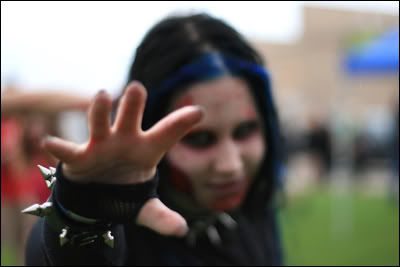
Our irregular look at artists throughout the universe of horror returns this time around with a gifted illustrator who has truly made the most of her prodigious talents, channeling them into the creation of all manner of chilling chotchkies. Nova Scotia's own Krystal Fancey Beck launched The Zombified in 2006, and uses the website to showcase, promote and merchandise the many kinds of items featuring her unique artwork. These items include anything from T-shirts and posters, to buttons and even comic books.
The Houston transplant was kind enough to speak to The Vault of Horror recently about her many endeavors...
You describe yourself as having been a "serial artist". Explain. As an artist, I've experimented in a wide variety of artistic mediums--pencil, charcoal, paint (and again, gone through a variety of paint types: acrylic, oil, watercolor, etc.), and of course my main love, ink. Furthermore, I've ventured into photography, website & graphic design, sewing, writing, a bit of sculpture... pretty much everything! Hell, I even dance--though I still haven't got the guts to perform. Basically, if it's creative, I have, or have had, an interest.
What items were the first you created? For The Zombified? Well, I started working on the Hallowhaus comic before I'd actually planned on doing art as a career, but I think the Halloween scene is the oldest design I have prints of available through The Zombified.
Which are you the most proud of? I'm proud of myself for not giving up on the comic after a couple of pages! I'm easily distracted, and that thing's a lot of work. That aside, I'm usually most pround of whatever I've most recently completed, though I'm not sure if it's because I'm evolving as an artist, or if it's just because I've had less time to pick out all the flaws.
Why do you feel that drawing in ink is your favorite method? I'm not sure, I just feel most comfortable with a pen in my hand. I like the contrast, the crispness of the lines. I'm not sure if I like that the permanence of it (you can't exactly erase ink that easily) leaves very little room for mistake or not.
Who are some of your inspirations? I'm hesitant to use the word 'inspire', but there are artists whose work I adore, and perhaps inspires me to try to become more awesome at 'what it is that I do'. But the inspiration for 'what it is that I do' seems to come from somewhere else. I get most of my ideas when I'm supposed to be asleep, perhaps the secret is in the insomnia. I digress. Artists I admire include Gris Grimly, Chad Savage, Keith Thompson and Ben Templesmith.
How did you get into creating comics? Which artists inspire you as far as that medium? As a kid I said I wanted to become a comic book artist, even though I didn't really have any ideas for a series or anything. Eventually, I decided that since I'd been saying that for ages, I should probably just go for it. I was never planning on showing it to anyone, it was just to sort of challenge myself and see if I could do it. I wasn't even planning on doing more than one issue.
I'm deeply inspired by anyone else who's doing their own thing, creating their comic from the ground up all by themselves, regardless if the quality or content is actually my 'thing'. As I mentioned, creating a comic is a hell of a lot of work, even if the artwork or story is fairly simple. In terms of my personal favorite comics, I'm particularly in love with Hellboy and, a bit more recently, Wormwood: Gentleman Corpse.
Tell me a little about the genesis of the story for Hallowhaus. I'm making it up as I go along, honestly. Which is another part of the reason there's a large gap between issues. I have a couple future projects in mind for after I've finished the Hallowhaus series, that might (hopefully) be a bit more planned out, but there's still the chance that I'll just grab a new idea and run with it again.
When and why did you first realize that this was something you could turn into a business? I was close to finishing the first issue of the comic when I learned of the glories of print-on-demand (yes, I know. But I have complete control of my work and can slack off when I'm not actually feeling inspired). I figured what I'd created wasn't entirely awful, started working on a few separate original designs, and just went for it. It was terrifying, since I had (have) the typical artist modesty (insecurity), but it's also been immensely rewarding.
What are some of the most popular items on your site? The mirrors seem to be most interesting to people, but it's the prints that sell the best. In terms of my designs, everyone loves the Mummy (which was actually one of the very first designs I did with The Zombified in mind), though at the moment my most 'favorited' one on DeviantArt is one of my newest, 'The Dead Will Dance'.
What does the future hold for The Zombified? More art, more comics, more awesome conventions like Texas Frightmare Weekend and Comicpalooza. A lot of the more interesting plans are a secret until I actually unveil them.
* * * * * * * * * * In addition to The Zombified and the aforementioned DeviantArt, Krystal's artwork can be found on MySpace, Flickr and LiveJournal, among other places.
What happens when you combine horror and science-fiction—those two vaunted pillars of genre entertainment? You wind up with some of the most fascinating, challenging, and downright kick-ass pieces of cinematic gold ever created. The key to great horror/sci-fi is maintaining that balance between the horrific and the…well, science-fictiony elements. This week, we here at the Vault, and the crew over at Brutal as Hell, have selected a bunch of films that do just that.
I've always felt that, generally speaking, science fiction's goal is to make you think, and horror's goal is to make you feel. One's intellectual, the other is visceral. Together, they make for a fascination combination, and this week I have a record-setting number of contributors chiming in to give us some prime examples...
B-Sol on Gojira
The absolute high watermark of giant monster movies--and I'm including the original King Kong in that assessment. If you've only seen this film in its watered-down Americanized edit as Godzilla, King of the Monsters, you're doing yourself a major disservice. Seen in its original Japanese version, Gojira is a stark, terrifying vision, a horror film in the truest sense of the word. In fact, if you're wondering why I'm writing about Godzilla on a horror blog, than you've clearly never seen this film.
Not to take anything away from the many films that followed, but Gojira is infinitely better than any of them. This is not a fun popcorn flick, good for a laugh with your buddies. This is cinema--a viewing experience that moves, and provokes thought. From the opening titles--one of the single most powerful openings credit sequences of any movie, for my money--it grabs hold of you, and doesn't let go.
Director Ishiro Honda is masterful at creating this aura of fear, but massive amounts of credit must also go to score composer Akira Ifukube, whose music is inextricably tied to the power of the film. It is hard to imagine the movie without his iconic score, as much a part of Honda's work as Ennio Morricone's compositions are to the work of Sergio Leone. By turns insistently dire, broodingly nightmarish and profoundly sad, Ifukube's masterpiece of a score is among the most effective ever written.
While The Thing was completely unappreciated in its time in the theaters, and roundly panned by critics great and small, over the test of time it has become one of the most beloved and fiercely defended horror films out there. At least this fanboy says so.
The alien creature in The Thing, as presented by two special effects geniuses, Rob Bottin and Stan Winston, is pound for pound, cell for cell, slimy tentacle for slimy tentacle, the scariest, most invasive and probably most dangerous movie monster of all time. It is no man in the "rubber suit." It is a monster of Lovecraftian proportion and perfection, but don't take my word for it... The incredible, pre-CGI effects steal the show, and are superior to much of what we get nowadays. But that is not why this is my favorite horror movie, or one of my favorite films of all time.
No, The Thing is so great because it has it all. The sets, though spare, were effective, especially on location in snowed-in Alberta. The synthesized Ennio Morricone score is simple, but a perfect match to the piano wire-like tension, and also was probably the inspiration for half of the theme songs of the 1980s. The camera work is perfect. The script is executed to near perfection, with each character built rapidly, yet effectively in each sequential appearance. The cast is excellent, with several very accomplished actors, and all in top form.
Unlike most films, much less of the horror variety, The Thing has an onion-like quality. What I mean is that it is a film that keeps on giving upon repeated views, not unlike a film such as The Godfather II, (I know, big comparison). When watched over and over, the significance of the "little things" comes to light, increasing the viewer's joy. An example is the scene when MacReady has been locked out of the compound. Palmer and Norris make statements sowing seeds of doubt about him, and when MacReady breaks in through a supply room window, they silently give each other knowing glances, and Norris says:"All right, all right, we've got no choice now!!" That little sequence gets better every time, and there are others.
Finally, R.J. MacReady is one of the great heroes in cinema, and I don't mean the Han Solo variety. In addition to being a world class drunk--meaning he doesn't let his copious hard drinking get in the way of saving the world--he is smart and ruthless. He rapidly picks up on the threat after only one warning, seizes control, and makes the correct calculation that there is no cost too high to prevail in the battle against the thing[s]. He is uncowed and unbowed by failure, terror and the terrible odds. When his chips are down, he goes all in.
I'm not usually one for movie sequels. We all know that they are usually (with some rare exceptions) inferior to the original, and usually just the studio's way of wringing some extra cash out of a successful intellectual property. The original Alien was one of the first four horror movies I had as a kid, when VCRs were a luxury item and movies on VHS were extremely hard to come by and very expensive (the other movies being The Thing, Jaws, and An American Werewolf in London). Alien always held a special place in my heart, mixing sci-fi and horror so seamlessly. So how do you top one of cinema's best sci-fi horror movies?
Enter James Cameron. Cameron took the concept of a vicious alien stalking crew members on a spaceship and just multiplied the horror a thousand-fold. For me, Aliens was a much more terrifying movie than the original because of the sheer number of aliens. I'm not afraid of a zombie. I don't think anyone is afraid of a single zombie. The horror of zombies is that there's dozens or hundreds of them, swarming you with a single-minded mentality. The cocky and technologically superior space marines are quickly overwhelmed by the aliens, who seem to be crawling out of every air duct, around every corner. The motion detectors showing hundreds if not thousands of aliens approaching their location was almost claustrophobic.
But the aliens weren't the only enemy. Paul Reiser turns in an excellent performance as the slimy company puppet Carter Burke, who has his own devious motives. Lance Henriksen, a staple of horror films, plays Bishop, another "unknown" amongst the crew. The android couldn't be trusted in the first "Alien;" could he be trusted now? Of course, Sigourney Weaver as Ripley continues to do an excellent job as the ass-kicking heroine, thus solidifying her place in movie history. Michael Biehn plays Hicks with a tough yet subtle calm. But Bill Paxton steals the show as Hudson, whose "Game over, man!" line has forever been immortalized in popular culture.
It's a shame the franchise went so off-course with the third and fourth movies. But Aliens is still one of my all-time favorite horror movies, and I watch it whenever it's on TV.
Many overlook the upsetting horror of 1997’s Event Horizon. Perhaps he sour taste of Paul W. S. Anderson’s previous effort with Mortal Kombat is to blame. But with Laurence Fishburne and Sam Neill as the principle roles, the film has a solid foundation of acting, and its chilling story and visual sensibilities have made it noteworthy among horror fans. Exuding a stylized sense of hyper-violence that The Texas Chainsaw Massacre coupled with Hellraiser, Event Horizon upped the ante, with its graphic depictions of death. There are no laughs or love interest, and there’s no hope to be found.
The story packs in a lot of theoretical elements, and really aims to create a unified vision of future space travel. By creating an artificial black hole, an experimental starship is able to travel vast distances through a gateway in the space time continuum. But this gateway actually opens a portal to another dimension: Hell itself. Unbeknownst to the rescue team that intercepts a distress signal from the missing starship, their boarding of the experimental rig will only trigger their downfall. The starship has returned with a supernatural presence aboard, and it begins to infect and kill the crew members in ghastly ways. With only 20 hours of oxygen, things go from bad to worse when their rescue ship is destroyed, forcing the crew to take shelter on the starship.
The special effects seem all too real, almost like a snuff film from the future. The quick flashes of Hell shown to Laurence Fishburne are almost too much to bear at their formatted speed; woe to those that watch them in slow motion. The film walks a fine line between philosophy and technology, fear and faith, religion and science, offering a solid example of sci-fi horror. But the one universal truth is that life is pain, and you’d wish for death before returning to where the abandoned starship has traveled.
Sadly, test audience research led many studio executives to the opinion t that the initial director’s cut was too unnerving, so they ordered a trimming of 30 minutes from the film, with large snippets to be taken from the graphic violence and gore. Anderson has said he regretted the edits, and one can feel for him, as he turned down the original X-Men to make Event Horizon.
I can’t say for sure when exactly I saw Night of The Creeps for the first time, though I am sure it was around the age of 11. I can tell you that I rewound it and watched it twice more within the same six-hour span. I was smitten. It blew my mind in a way I couldn’t remember a film having blown my mind before. I had seen Alien and I had seen Predator, but here was a straight-up horror film with sci-fi elements. I felt like this was meant for me for some reason. I guess I had never really been a huge fan of sci-fi--hell, I can’t really say I am the biggest one now. But NOTC took me in, sat me down and made it OK to be fully embroiled in a sci-fi mindset.
The film itself focuses on Chris Romero (Jason Lively) and JC Hooper (Stephen Marshall) as they unwittingly unleash an alien-infused zombie epidemic on campus. And if you’re thinking they’re named after George A. Romero and Tobe Hooper, you’re 100% correct. Another great nod comes in the form of classic bad-ass cop, Ray Cameron (yes, named after James Cameron, a friend of Dekker’s) as played by veteran actor Tom Atkins. To this day Tom Atkins says of his storied career, this is his favorite role of all time.
It’s truly remarkable now as an adult when I realize what a feat Dekker’s first film was. When I first saw it I just remember the childlike wonder as I saw the “creeps” slither for the first time, and when I saw the first head explode only to be eviscerated further by a flamethrower. The special effects were done by three hugely talented artists; David Miller of the Nightmare on Elm St franchise, and Howard Berger and Robert Kurtzman who would soon go on to KNB EFX along with Greg Nicotero.
I recently had the pleasure of meeting both Fred Dekker and Tom Atkins in person. The T-shirt company I work for, Fright Rags, hosted a double feature of Night of The Creeps and The Monster Squad here in Rochester, New York. I spent an entire weekend with one of my film-making heroes, and a living legend. It was a fangirl dream come true. I have more memories than I can include in one post, but one conversation that I found quite interesting was on the subject of James Gunn’s Slither. I am one person who wholeheartedly looks at it as a rip-off of Creeps . Fred said that James Gunn vehemently denies this, and that he could indeed be telling the truth. Fred said when his film came out, that people accused him of ripping off an old sci-fi film he had never even seen. His message was to simply understand that there is never a definite answer when it comes to those accusations. Maybe he did get ripped off, but so be it, Fred Dekker has far more on his mind than to worry about it. Another sidebar: The line that Atkins delivers, “Good news is your dates are here, bad news is they’re dead,” was from a day of pick-ups, and improvised.
All in all, what do I have to say about Night of The Creeps that hasn’t been said before? Maybe nothing different, but the point to be made is, if I had to choose my favorite sci-fi horror film of all time, I would choose Night of The Creeps. Go ahead, Thrill Me!
Even a seasoned sci-fi fan wants something different once in awhile. Moon is one of those films. While at first it seems like you may be watching a rehash of 2001: A Space Odyssey, you soon realize things are not as they seem. And if I do say so, Sam Rockwell really puts on a tour de force performance here, carrying nearly the entire movie by himself. Written by Duncan Jones, Moon tells the story of one Sam Bell, an employee of Lunar Industries, Inc. who is nearing the end of a three-year contract in which he is alone on the moon, extracting helium-3 to be used as energy for Earth. His only companion for the long venture is GERTY (voiced by the wonderfully monotone Kevin Spacey)--think HAL, but less controlling. Sam is anxious to get back to his family, a wife and daughter which he can only see through long distance video hookup pre-recorded transmissions that are far and few between.
The scares here are mostly psychological, which to me is more than just creepy when you're the only one on an entire planet. But then again, is he?
Moon succeeds on so many levels. The feeling of complete and utter isolation is so tangible here, so frightening, that you can't help but to be a bit anxious. GERTY, while certainly Sam's only friend and confidant, still has us curious if "he" knows more than he is letting on. The movie keeps you wondering--you'll be guessing, and you'll be wrong. Confusion abounds, but not in a Memento kind of way. It's a good confusion, one you will be thinking about long after the final few moments.
I'm not your average sci-fi fan. I love Alien, The Thing, and am a huge X-Files fanatic, but I'm not as well-versed in the sub-genre as many others. But Moon comes highly recommended. It's one of my favorite films of the last year.
Hardware was the last of the post-nuke films to get a theatrical release. Audiences didn't get it. Critics were all over the place on their feelings for the film. As a result, the film flopped at the box office and the post-nuke genre died down after soaring with films like Mad Max and The Running Man. Hardware takes place during the Christmas season in the post-nuke future, as a scavenger (Dylan McDermott) presents his artist girlfriend (Stacy Travis) with some robot parts. After a passionate night together, the robot reassembles itself to continue on with its life mission--population control.
I was lucky enough to catch this back when it was released in theaters. I was only 8 or 9 at the time, but it was a breathtaking experience for me. The visual aesthetic of the film captivated me. The film's pulsating techno score by Simon Boswell added to the excitement of the film's on-screen carnage and gore (which had to be trimmed to avoid an X rating). A shocking death about two thirds into the film added to that breathtaking factor for me.
As I got older, I was able to appreciate to an even greater degree that Hardware was one film that didn't play by genre rules and was willing to take chances. From director Richard Stanley's claustrophobic, voyeuristic atmosphere. To his willingness to try out experimental camera angles and to commit to one of the bleakest portraits of the future ever portrayed on screen. The colorful supporting cast included the likes of character actors John Lynch and William Hootkins, mixed with musicans like Iggy Pop, Carl McCoy of the goth band Fields of Nephilim, and Lemmy of Motorhead. The use of religious iconography and references contrasted against the film's strong use of sexuality and violence gives it a bit of a sense of irony.
Hardware went pretty much ignored during the '90s, but luckily for us, the film gained a cult following over the years and went on to receive both a DVD and Blu-Ray release. Hardware is hands down my favorite film to mix elements of science fiction with horror. It also ranks as one of my top five favorite films of the '90s.
From my point of view, the most plausible dystopias are the most menacing ones, and Soylent Green (1973), set a mere twelve years on from the time I’m writing this, seems increasingly, uneasily recognizable. The 2022 of the film--riddled with environmental damage, grotesque overpopulation, hunger and an increasing gap between rich and poor--could so easily be our own legacy, and Detective Thorn’s final discovery speaks a familiar language of corruption, bleak utilitarianism and desperation. ‘Desperation’ is the single word I’d choose to sum up Soylent Green: it runs through the film like a seam; in its malnourished masses, its non-status women and its euthanasia depots (the latter providing one of the film’s most poignant--and most appalling--scenes).
But, for all that palpable desperation, all that horror, there’s a real sense of humanity here, too. Detective Thorn (Charlton Heston) has a long-standing friendship with Sol (Edward G. Robinson in his final role). They take a real pleasure in life, in each others' company: when Thorn can get hold of ‘luxury’ food items, he shares them. Thorn also loves Shirl (Leigh Taylor-Young), and implores her to ‘LIVE!’, to get any happiness she can, when he is no longer able to protect her. And, of course, Thorn’s determination to get to the bottom of the ‘Soylent Green’ brand mystery comes from his sense of decency and honesty. Ultimately, there’s a grain of hope here that basic humanity can remain intact, can avoid being consumed, even when humans are unwittingly consuming each another. Humanity stands opposite the cold rationale of the Soylent Corporation, so when the tagline declares ‘People are still the same’, perhaps that bleakness has something positive embedded within it, even when a startling and ambiguous ending keeps us wondering.
Profound, clever, with a stellar cast and a pervasive, disturbing atmosphere, Soylent Green derives both its horror and its hope from a hell that might be right around the corner…
Though there's no good reason, from a technical (or even logical) standpoint, that I should call this my favorite film in which the sci-fi and horror genres cross their streams; I'll be damned if I don't have an immense amount of love for Jack Harris & Irvin Yeaworth's production of The Blob. A large reason for this was the impact the film had on me at a young age--it was one of the first monster movies I was allowed to watch on VHS--but time has only helped the film tunnel its way deeper into my heart.
It was the late 1950s, and Harris' idea was simple. Take two of the most popular sub-genres going--Earth-based science fiction and teenage delinquency drama--and put them together in one film. (To the trained viewer, there's no hiding the fact that this movie borrowed more from Rebel Without a Cause than any of the “Watch the Skies!” films of the '50s.) This didn't matter to me when I was a kid. I was too busy pondering how the Blob worked and wondering how big it could get if it kept eating. The kids were running around trying to convince the adults that they weren't just punks, and I was too busy trying to figure out how many people Sir Blob would have to eat to get big enough that he could cover my family's entire house. And I loved it.
But with age, I've come to love the human aspects of The Blob just as much as any of the carnage the gelatinous carnivore starts. Unlike other teen flicks of the era, there's so much hope for humanity at work in this film. These kids fit the same stereotypes that films like Rebel put them in...and still go out of their way to help others. There's no bad guy who's out to settle a petty score, and there's no evil mastermind who we need to hate. As a film, The Blob breaks from dramatic traditions, showing that it understands that people aren't generally as bad as movies paint them to be.
Of course, I wouldn't be ranting about this sentimental favorite if it didn't have one of the most fun monsters ever put on screen and a slew of horror and sci-fi staples. They were the hooks that got me to watch the film, and they still bring me back to it frequently. But when I look past those hooks, and remember how much I love the film's ability to spread hope alongside its camp and fear, I'm reminded why The Blob still stands as one of the most beloved flicks I've ever known.
John Carpenter immortalized this one by making it a part of Tommy Doyle and Lindsay Wallace’s Halloween night monster movie marathon in 1978, but it was always destined to be a classic. Few films manage to capture a dread sense of isolation and paranoia as well as The Thing From Another World; released at the dawn of McCarthyism and the UFO craze in a post-atomic world, the film conceptualizes all of these very real fears into a horrifying story (as good science fiction often does). The mysterious, single-minded monster that’s “devoid of morality” represents anti-Communist rhetoric that no doubt was frightening Americans from coast to coast.
Even stripped of its historical and allegorical contexts, it’s still a great, suspenseful monster movie. The titular creature is brought to life by James Arness, and the hulking monster tears apart everything in its path. The isolated, arctic setting intensifies the suspense by creating no escape for the protagonists. However, in typical fashion, these characters might be more of a threat to each other than the monster is; though the creature isn’t a shape-shifter like in Carpenter’s redux, the situation still creates a natural dissension and paranoia among them all. It’s a standard horror motif that’s been used countless times since: a group of survivors trying to keep itself from unraveling while fending off something hideous (George Romero has practically made a career out of this plot).
In particular, The Thing From Another World presents a divide among military and scientific lines, with each side battling to determine the fate of “The Thing.” Captain Hendry wants to destroy it, while Dr. Carrington wishes to study it to learn from it, no matter how deadly the results. This conflict might be the film’s ultimate legacy, because it’s one that’s shown up a number of times since, with each side taking their share of the blame over the years. Here, Carrington, the meddling scientist, is the untrustworthy character that reminds us of how dangerous unbridled scientific ambition can be.
At the end of the day, though, it doesn’t matter who comes out on top because the movie preys on the fear of the unknown to the end. For a '50s monster movie, it’s rather ominous and plays well as a spookfest on Halloween or any other cold, dark night. Even as the film comes to a close, we’re warned to “keep watching the skies,” because something might still be out there, waiting…
Planes, trains, and extraterrestrials… Horror Express is not your average alien-goes-amok story. After hearing about this film a few years back, I finally took the time to sit down and watch it on one of those glorious 50-film packs that you can find in the dusty recesses of the bargain bin. I was astounded by what I had seen; for all the typical trappings of a Eurotrash feature with cheesy, rubber-suited monsters, this little chiller was quite effective. I have subsequently re-watched and resoundingly enjoyed this film more than some may think it deserves.
The story is entertaining in and of itself. Sure, the science may be hokey and totally off-the-wall, but the craziness only serves to make the film that much more enjoyable. You can’t help but grin as the scientists calmly reason the possibility of an intergalactic mental vampire sucking passengers dry on the very train they’re on.
With the added benefit of having Christopher Lee and Peter Cushing in the film, it’s guaranteed to serve as a full evening of entertainment. The duo’s chemistry is spot-on as always, both of them playing rival scientists here. While they may be a bit competitive and pushy towards one another, they actually stick together and work as a team for the majority of the film. It’s a delight to see them as partners instead of being at opposite ends of a wooden stake. Lee goes about with his usual somber and demanding presence, while Cushing lightens things up with his ever-affable and charming personality. He also gets probably the best line in the entire film. When accused of being possible hosts for the galactic monster, Cushing responds with genuine shock: “Monsters? We’re British you know!” Telly Savalas pumps some sadistic energy into the piece when he shows up later as the iron-fisted Captain Kazan, rounding out an already impressive cast.
Upon viewing the film recently, I was also taken by how astounding some of the musical pieces are. Especially awesome is the heavy bass that plays every time the creature’s eyes glow that ominous red as it prepares to kill. The pacing of the film is just perfect, each minute growing with more tension as the alien stalks about the claustrophobic aisles of the train. It all builds and climaxes in an appropriately fiery finale that caps off this terror from beyond the stars in a most satisfying manner. If you haven’t already heard of this film, it comes with my highest recommendation. You may be prone to just throw it away as another cheapie feature, but Horror Express is probably the most exciting and charming ride you’ll take into the dark realms of sci-fi madness for a while.
Originally, I was set to write a love letter to Ridley Scott's Alien--until yesterday when I found myself trying to explain to a skeptical friend of mine why Forbidden Planet is so cool. If you were to make a venn diagram of horror and science fiction, the crossover would be ridiculous. The human race, in general, has a strange fear and fascination with technology, so there's not a lot of sci-fi out there that doesn't have at least one foot in horror territory. Forbidden Planet is no different. Inspired, at least a little bit, by Shakespeare's The Tempest, a spooky favorite or writers looking to add horror and mystery to their scripts, the film easily qualifies as my favorite sci-fi horror flick, as well as my favorite flying saucer movie.
A crew of astronauts are dispatched to the planet Altair to investigate the disappearance of an expedition lost some 20 years earlier. What they find is that the missing Dr. Morbius has set up a permanent home on Altair with his daughter Altaira and robot servant. There he survives using the amazing technology left behind by a long dead race called the Krell; but a powerful and invisible force keeps them there, and intruders out.
It's a killer flick from top to bottom. I can't find a single negative criticism to level against it while I explore it. Forbidden Planet is a seriously broad vision at the height of the flying saucer phase in Hollywood. In 1956, everyone was still aping every move from The Day The Earth Stood Still, and the era produced some of the shoddiest, crappiest science fiction in the entire history of Hollywood. But Forbidden Planet took a different route and chose to eschew the entire notion of the red scare in favor of something a little more classic hidden beneath a slick science fiction veneer.
The cast is absolutely astonishing, featuring Leslie Nielsen, better known for his zany comedies, in a serious role as the ship captain, and the flamboyant Walter Pidgeon as Dr. Morbius. Anne Francis is beautiful and hypnotic in every scene, and her costuming covers just enough of her to keep the censors at bay. To top it all off, we're treated to a set of stunning special effects and amazing sets and props. The C-57D flying saucer and the iconic Robby the Robot suit go on to make many appearances on The Twilight Zone, and this fantastic setting is rounded out with some amazing matte paintings that convey the sheer size and anthropology of Altair. It's amazing, I tell you! But we're not done. Often mistakenly believed to have a full-on theremin score, Forbidden Planet is scored by musique concrete masters, Louis and Bebe Baron. A multi-layered soundtrack of circuitry modulation that sounds alien and psychedelic at all times, Forbidden Planet's score is the first all-electronic score.
I really can't say enough about this piece of classic sci-fi. Afficionados celebrate it until the cows come home, but I have such a hard time selling your average movie viewer on it. Forbidden Planet is timeless!
* * * * * * * * * *
Now head over to Brutal as Hell to see what Marc Patterson and his crew have come up with. And if you're interested in taking part in the FINAL installment, just give Marc or myself a holler.
Make yourself comfortable tonight, ladies and gentlemen. Because this time around, we have a very special, double-length edition of Conversations in the Dark. As part of the ongoing Lucky 13 series in which both the Vault and Brutal as Hell are currently embroiled, I was originally going to be joined by BAH's Britt Hayes for back-to-back weeks, discussing both the recent zombie edition and upcoming sci-fi edition of The Lucky 13. But plans changed, and so instead we combined both into one mondo, 90-minute Vaultcast.
Fortunately for you, we happen to be two individuals with very radio-friendly voices, so it won't be too unpleasant to listen in as we ramble on ecstatically about both the living dead and the horrors of science fiction, along the way leaping madly into random non-sequiturs involving everything from the merits of Nic Cage's career and the hotness of Cillian Murphy, to the glories of the Anthony Weiner tirade and why the Friedberg/Seltzer spoof movies may be signaling the apocalypse.
You can listen on the embedded player below, or over at the official Vaultcast page. Download it right here--proud to declare, by the way, that the Vaultcast has grown so popular that I had to upgrade to a pro account on PodOmatic in order to accommodate all the bandwidth. Keep listening! My wallet doesn't thank you, but I do!
Horror is a very image-driven genre, centered as it is on eliciting primal emotional responses. And so, it's perfectly suited to the brand-new meme bouncin' around the blog-o-sphere, on which yours truly has been tagged. That's because it's an image-based meme, in which bloggers are urged to come up with a series of screen grabs, all focusing on a specific theme. The whole thing was kicked off a little while back over at the blog Checking on My Sausages, and I got pulled in after being tagged by my dear colleagues/readers Leopard13 of Lazy Thoughts from a Boomer and John Kenneth Muir of Reflections on Film/TV.
Seeing as this is a horror blog, don't be expecting this thing to resemble an Anne Geddes calendar. The theme I chose goes to the very root of what I believe makes horror horror--the fear of death. Or more specifically in horror's case, the fear of being killed. And so I've chosen a whole bunch of scenes of people being offed which I found particularly striking.
But before I get to that, I must get to this. As one of the conditions, I must now tag five other bloggers to continue the meme if they so choose. And so I select:
If the path he's on is any indication, there may come a day when Estevan Vega is too big a deal to grant interviews to sites like this one. But at the moment, on his rise up the blood-soaked ladder of horror fiction success, I had a rare opportunity to sit down and speak with the young man, thanks to Vault contributor Marilyn Merlot, who first brought Vega to my attention and made this interview possible.
A fellow resident of the state of Connecticut, Vega has been writing since childhood, and in fact the work that would become his first published novel, Servant of the Realm, was begun at the age of 12. Since then, he has published the dark, psychological thriller The Sacred Sin, and the 21-year-old's third novel to date, Arson, published this past May. Find out more about Vega, Arson, and his other books at the author's official website.
What first inspired you to want to become a writer? Was horror always the genre you were interested in getting into? My dad has been a huge inspiration for me. If it weren't for my father, Joe Vega, I wouldn't be a writer. He actually pulled me away from the television when I was in fifth grade and helped me write my first short story, which my teacher ended up giving me an A for. It was sick! I started to enjoy writing these stories, and the grades rocked. It was just awesome to have someone want to read something that I had written. So I decided to start writing a book. I thought, "Why not?" I have always flirted that line between horror and the supernatural. I really like doing that. When I go into a book or into a movie, I love that unsettled feeling right in your gut, so I try to emulate that in my writing. Am I horror? Hmmm... Am I real? Hmmm... Am I a writer who loves both and also gets stoked for the supernatural? Oh, yes!
What writers in particular did you look up to or enjoy reading and why? Stephen King. He is kinda the guy to aim for as far as being a writer. I also really enjoyed stuff by Edgar Allen Poe and Ray Bradbury. I like Ted Dekker... he can write some eerie stuff sometimes. I try to get into a bunch of writers, because it allows me to get new concepts, try different perspectives and so on. Each writer has something to say, and it's cool to bounce around. But I always looked up to King. He's just accomplished so much in his lifetime. Oh, yeah...I'm jealous.
Talk about the genesis of your very first novel and how you got yourself published. I started Servant of the Realm when I was 12. I had this crazy idea that I'd be famous by the time I hit prom. I was ridiculous. But I was set to change the world with my words. I ended up working on that, and a few drafts later had a book I wanted to actually see in print. So I just started submitting it places and published it with the first person to say they liked it. Maybe not the smartest choice, but you live and you learn, right? Since then it's been a crazy six years.
How useful has the internet been in growing a fan base and getting the word out? Immensely important. The internet has helped me spread the word about myself using a website, Facebook, Twitter. I've also done interviews like this and with internet radio, and blog tours... none of that would be possible. It's allowed me to get people from around the country and around the world to hear about Arson and about me. It's been a sick tool in spreading the fire! Plus, email and the social networking sites allow me to connect directly with my readers in a way that just ten years ago might not have been possible.
What themes are important to you in your fiction? Regret. Loss. Love. Fear. Redemption. All of my books deal with these in one way or another.
How would you say your latest book, Arson, is different from your previous work? Very different but very similar. You can still tell it's me writing it, for those who've read either Servant of the Realm or The Sacred Sin. But the writing has just improved. I've learned a lot in the few years since my last book. I focused intensely on the characters in Arson, more so than I've ever done before. The people are far more important than the situations they face, though those situation do play a role in defining who they are. But I suppose where the three books stray from one another most would be the mood. It's a very slow burn kind of sensation that you'll get while reading Arson. One of those feelings that you're not sure why you're getting that way or where it's coming from, but it stays with you. It's real. I love that. Arson's also my first book to take place in Connecticut, which is cool.
What would you most compare it to? How would you describe it to someone who knew nothing about it? It's been compared to Firestarter, Twilight, Jumper, Odd Thomas. A lot of people are really getting into it. If you haven't had a chance to check it out, you gotta. It's a cool story. Arson is basically a story about a boy who is trying to grow up. He's struggling with the pressures of maturity, but also coping with the fact that he can start fires with his mind. In some ways, it's a typical story about a boy who has a crush on the hot girl he can't get... but it goes so much deeper than that, it really does. It's got a bit for everybody: boy with superpowers, chick with a mask, psychotic grandmother, and a whole lot of family dysfunction.
Do you have any interest in your work being adapted into movies? Are you serious? Of course. A few people have shown some interest, but I'm just waiting for the right deal. The book's only been out about 2 months, so I can wait for the phone to ring a bit more. But yeah, Arson would be a sick movie. I have always envisioned my books as movies.
What do you think of the state of horror fiction today? I think it's a bit splintered. There are people still doing it and doing it well, but even King has broken off the beaten path some to explore other styles of writing, as Anne Rice has done, and I think that's great. Splintered is okay. I do think that horror can be experienced in many different ways, though. Something doesn't have to jump out and make you crap your pants in order to be horrifying, and that's the beauty of writing. You can literally horrify someone and not even be classified as a horror writer, but then you can spook someone only a little and everybody freaks out.
If you could give any advice to aspiring horror fiction writers, what would it be? Just freakin' write. If you're passionate about something, it'll show. Study other writers. Know your competition and the market. Think about what terrifies you and see if you can make somebody else feel that same feeling. And... burn something.
So the big announcement has been made, that Brad Pitt will be playing the lead in the upcoming World War Z movie. I kind of thought this was a foregone conclusion when Pitt's production company optioned the novel about four years ago, but oh well...
One announcement which was far less predictable was the news coming out of Comic Con that Guillermo "I Have 683 Movies Currently in Development" Del Toro will be getting to work on a big-screen adaptation of H.P. Lovecraft's seminal novella At the Mountains of Madness, to be produced by Jim Cameron, no less. I suppose if Del Toro had to drop out of The Hobbit, this revelation makes it somewhat more palatable. The director's work on Hellboy proves to me that he has a firm handle on ol' Howard Phillips' oeuvre.
For all those either too young or not from around my neck of the woods, you may not be aware of it, but beloved character actor James Karen, best known for his roles in Return of the Living Dead and Poltergeist, was for many years the TV pitch man for a supermarket chain here in the Northeast. So that's how I knew him as a kid, long before I saw those movies. Just thought I'd share that bit of random weirdness.
After recently debating the eligibility of parole of Mark David Chapman, John Lennon's murderer, I've come to the conclusion that there needs to be a pilgrimage to the famous Dakota Hotel on Manhattan's Upper West Side. And not because it was where Lennon lived--no, there's been quite enough of that. We need to organize a pilgrimage of horror fans, because of the other reason the Dakota is famous--it's where Rosemary's Baby was filmed! So who's with me?
Was I the only kid who used to get scared of that giant walking pile of orange hair in sneakers from the Warner Bros. cartoons?
I really do feel that the new season of True Blood has been getting better with each episode, which is a good thing. But someone explain to me why we need to have this protracted storyline about Sam and the dog fights? This kind of superfluous storytelling, used to fill time and keep characters busy, is one of the pitfalls of episodic drama. If it ain't vampire-related and doesn't tie into Bill or Sookie in some way, I don't need it.
Eight-year-old Zombelina has been begging me to let her watch Jaws as of late, and I must say, I've been hesitant. Seems all the kids at camp have seen it (damn that's a rather hip bunch of fourth-graders, is it not?) and she yearns to join the conversation. But I'm not totally sure she can handle it. The usual parental tactics are not working--I may need to teach this lesson the hard way. Will report back.
Some may remember quite a while back, I reviewed a documentary on the history of horror films called Nightmares in Red, White and Blue, from director Joe Maddrey. Well, I'm proud to say that after some time struggling for distribution, the doc is currently available on a number of on-demand platforms, and will also be available on DVD starting September 28. For more info, go to the movie website. Can't recommend this Ken Burns-like look at the genre strongly enough.
If you'd like to be the proud owner of a poster from AMC's upcoming Walking Dead TV series (and who wouldn't, really?) then I advise you proceed to The Spooky Brew, where Maweanne, fresh from San Diego Comic Con, is giving one away! Yay, contests!
Long-time Friend of the Vault Christopher Zenga will be making his art available to buyers at the Toronto 2010 FanExpo, from August 27-29. It's a great opportunity to buy prints, or even have a custom zombie portrait done. Check out Chris' stuff right here.

 Our irregular look at artists throughout the universe of horror returns this time around with a gifted illustrator who has truly made the most of her prodigious talents, channeling them into the creation of all manner of chilling chotchkies. Nova Scotia's own Krystal Fancey Beck launched The Zombified in 2006, and uses the website to showcase, promote and merchandise the many kinds of items featuring her unique artwork. These items include anything from T-shirts and posters, to buttons and even comic books.
 You describe yourself as having been a "serial artist". Explain.
 What items were the first you created?
 Who are some of your inspirations?
 Tell me a little about the genesis of the story for Hallowhaus.
 What does the future hold for The Zombified?


