"A REALLY INTELLIGENT INTERVIEWER." -- Lance Henriksen
"QUITE SIMPLY, THE BEST HORROR-THEMED BLOG ON THE NET." -- Joe Maddrey, Nightmares in Red White & Blue

**Find The Vault of Horror on Facebook and Twitter, or download the new mobile app!**

**Check out my other blogs, Standard of the Day, Proof of a Benevolent God and Lots of Pulp!**


Showing posts with label An American Werewolf in London. Show all posts

Saturday, December 31, 2011

Three Decades of David: The Man Behind the Wolf

I'm closing out 2011 with one last edition of Three Decades of David, my year-long celebration of the 30th anniversary of An American Werewolf in London. This time out, we take a look at the man who brought this visionary and influential horror film to life, and one of the most underrated directors in the entire horror canon, Mr. John Landis.

Known equally for his work in comedy and horror, Landis has been a fixture in Hollywood since the late 1970s, when he exploded onto the scene with National Lampoon's Animal House, the film that established him as a top filmmaker. Nevertheless, filmmaking had been a passion for the Jewish-born Chicago native since he was a small child absorbing in amazement the work of Ray Harryhausen in movies like The 7th Voyage of Sinbad.

In fact, it was 7th Voyage that first put the directing bug in the boy's head, as he started wondering exactly whose job it was to make movies, and if he could take part. So from the beginning, it was the fantastic and surreal that drew Landis to the world of directing, and that attitude would be reflected in much of his later body of work:
I had complete suspension of disbelief—really, I was eight years old and it transported me. I was on that beach running from that dragon, fighting that Cyclops. It just really dazzled me, and I bought it completely. And so, I actually sat through it twice and when I got home, I asked my mom, “Who does that? Who makes the movie?” - The Film That Changed My Life, by Robert K. Elder
Landis got his start as an assistant director in Yugoslavia on the 1970 war comedy Kelly's Heroes, and also spent some further time in Europe assisting on movies like El Condor and Sergio Leone's Once Upon a Time in the West.

His actual feature film debut came in 1971 at the age of 21, when he wrote and directed the low-budget monster movie tribute, Schlock. But most of the '70s were tough for the young Landis, as he tried to break into Hollywood, taking any odd job he could along the way. He got a major break in 1977 when he directed the Zucker brothers breakout Kentucky Fried Movie, but it was Animal House a year later that put him on the map.

It was that movie that pushed Landis into a vibrant creative circle that included hot directors like Steven Spielberg and many of the masterminds behind America's new cutting-edge sketch comedy series, Saturday Night Live. In fact, his next feature would be the first film to be adapted from an SNL skit, namely The Blues Brothers starring Dan Akroyd and John Belushi.

His name established as a comedy director, Landis at last felt comfortable delving into an area that had long been his passion: horror. When he got the word out that his next project would be a personal labor of love called An American Werewolf in London, a lot of people were surprised that the director of such happy-go-lucky, light-hearted fare was tackling such a supposedly heavy project. Little did they know how close to his heart the material was. Actually, the original concept came to Landis while working on Kelly's Heroes in Yugoslavia, when he witnessed some peasants burying a man suspected of being a werewolf.

For 12 years, Landis had nursed the AWIL project, and to this day it is considered by most to be his finest work. Deftly weaving black comedy and real horror in a way not quite seen before, Landis crafted a truly innovative, preeminently influential motion picture, one worthy of being called one of the greatest fright films of all time. Best of all, he brought his unique comic sensibility to the project, making it a movie that's pretty tough to compare to anything else.

Finally having broken through to the genre he cherished best of all, Landis continued on for a bit in the horror vein, joining forces with none other than Steven Speilberg to produce a movie based on the classic Rod Serling TV series, The Twilight Zone. Also directing a portion of the anthology film, Landis ran into some serious trouble that nearly derailed his career when famed actor Vic Morrow and two child extras were accidentally killed in a helicopter during filming. After a trial for involuntary manslaughter and child endangerment, Landis and company were acquitted of all charges, but the tragedy and controversy has haunted the producer/director to a certain degree ever since.

Regardless of the Twilight Zone debacle, the 1980s was something of a golden era for John Landis. He would go on to direct the most famous music video of all time, Michael Jackson's "Thriller", which is in and of itself something of a horror short subject. He then settled back into his comedy comfort zone for much of the decade, putting out fondly remembered '80s flicks like Trading Places, Spies Like Us, Three Amigos and Coming to America.
If the 1980s was a golden age for Landis, then his directorial career took a decided dip into silver or bronze territory in the 1990s. This was the decade that gave us the Sylvester Stallone turkey Oscar, and the ill-conceived Tom Arnold vehicle The Stupids. Even a return to the franchise that once brought him such acclaim resulted only in the completely forgettable Blues Brothers 2000. Similarly, Beverly Hills Cop III did nothing to change the trend.

Although certainly not anywhere near the same ballpark as American Werewolf, Landis did make a brief return to horror in the 1990s with the vampire/gangster comedy Innocent Blood. While entertaining and possessing something of that Landis horror/comedy spark, it was a far cry from what the director had accomplished a decade prior.

Perhaps recognizing this downward trend, Landis shifted gears in the new century, turning to documentary filmmaking for much of the first decade. And now, the producer/director has reportedly shown interest in returning to the horror genre in the coming years, a rumor which is supported by his executive producing of last year's underground horror/comedy hit Some Guy Who Kills People.

Although his body of work can adequately be described as erratic, John Landis nevertheless deserves recognition as one of the brightest, visionary genre directors of his time. Just the achievement of An American Werewolf in London alone would be enough to afford him a fond remembrance in the hearts of horror and comedy fans. Add his successful SNL-alum comedies of the 1970s and 1980s, and you have a filmmaker who more than made his mark on his era.

Inspired by genre great Ray Harryhausen in that darkened theater, Landis grew to become a genre great himself.


Three Decades of David:

The Movie That Changed Werewolf Movies (And Horror!)
How the Dr. Pepper Pitchman Became a Horror Icon
The Music of An American Werewolf in London

Sunday, November 20, 2011

Three Decades of David: The Movie That Changed Werewolf Movies (And Horror!)

In 1981, the werewolf movie was dead in the water. Done and done. A curious relic of horror history. And then, along came John Landis' landmark An American Werewolf in London, and the game was immediately changed forever.

So much change was brought into being as a result of this movie, in fact, that we often may take it for granted and not fully appreciate the amount of evolution it lent the ailing subgenre. Let's take a look at just a few of the ways that An American Werewolf in London transformed lyncanthrope cinema--and along the way, the entire horror category.

FROM WOLF MAN TO MAN WOLF

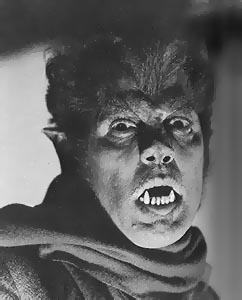
Prior to AWIL, the movie werewolf was a curious creature, who was actually not very much of a wolf at all. Rather, as he was best described in the 1941 Lon Chaney Jr. classic, he was more of a "wolf man"--that is to say, a humanoid being with some of the more fearsome qualities of a wolf tacked on for horrific effect. This was not at all in line with the creature as described in traditional folklore, but it was necessitated by the level of makeup and special effects technology available in those early days of film.

It was a lot easier to take someone like Chaney or Henry Hull and add some lupine features--some fur and fangs, maybe a dog-like nose or ears. This is not to denigrate the work of such legends as Jack Pierce, but the fact remains that the werewolves depicted in movies prior to AWIL were much more man than wolf.

By the time we get to Landis' masterwork, and the contributions of that film's effects wizard, Rick Baker, we've got a whole different monster on our hands. For the first time, a werewolf was created that actually looked more like a monstrous wolf than a hairy dude in ripped clothes. The wolf we see here is not a true wolf like we would find in the natural world, but rather a demonic creature that is decidedly lupine in nature, but with a very cruelly human intellect behind its animalistic violence.

An American Werewolf in London stressed the wolf in werewolf, and set a trend that would be commonly followed in many other horror films. Sure, the "wolf man" template would still be replicated many times, but Baker demonstrated that it was possible for a human character to transform into a true wolf-like being.

DRAMATIC CHANGE... LITERALLY

Again, not to cast aspersions on the work of some of Hollywood's finest special effects geniuses, but what passed for a werewolf transformation on screen prior to An American Werewolf in London is very different from what audiences came to expect as a result of it. The time lapse photography work and other of Pierce's techniques seen in films like The Wolf Man and Werewolf of London were impressive for their time, and are still a hoot to watch, but remained within a boundary of what could be accomplished then--a boundary that would be shattered by Baker and company.

Starting with AWIL, the metamorphosis scene became something of a centerpiece of a werewolf film, the money shot that audiences waited for. It became a much more dramatic, intense, drawn out special effects extravaganza. David Naughton's transformation is an involved affair--a tense and nightmarish explosion of kinetic energy that is a far cry from Lon Chaney passively sitting in a chair as hair sprouted from his face.

It was also important to both Landis and Baker that the audience understand the pain involved in turning into a werewolf. Apparently, it hurts like hell to change into a monster--which would make sense, although it should be pointed out that the original folklore stresses the transformation as magical and not physical, thus no real pain. Still, thanks to the efforts of Landis and Baker, we get a sense of every cracking bone, popping sinew and contorting limb. The modern werewolf is thus a strange cross-breed of the enchanted and the biological.

WEREWOLVES AND POST-MODERNISM

From very early on, we understand that the characters in An American Werewolf London live in a world with all the same references we have. All the werewolf movies we know and love exist in this world; everyone knows the rules. References to movies such as The Wolf Man are made throughout the film, and in fact David explains how Larry Talbot had to be killed by his own father--someone who loved him--foreshadowing his own end at the hands of his girlfriend Alex.

A decade and a half before Scream, and nearly a quarter of a century before Shaun of the Dead, AWIL gave us post-modern irony in horror. We have characters who know the score--unlike characters from earlier horror flicks, who seem to live in a plastic bubble in which horror flicks don't exist. This self-referential style may be the single most influential contribution that An American Werewolf in London made to the history and development of the horror genre.

Not just one of the greatest horror movies ever made, An American Werewolf is smart horror. It turned its own subgenre and the entire genre on its head, and we've been feeling the effects ever since. It revived the werewolf for decades to come, giving it a whole new spin and a literal rebirth in the process. How fitting, that a concept based largely on the theme of transformation would be so profoundly transformed.

Sunday, June 5, 2011

Three Decades of David: How the Dr. Pepper Pitchman Became a Horror Icon

If at least part of your childhood was spent in the 1970s, as mine was, then you probably remember those ubiquitous commercials for Dr. Pepper, in which a handsome young man led a crowd of dancers through the streets, in Pied-Piper fashion, all the while singing the catchy jingle, "I'm a Pepper." It was as much a part of the era as G.E.'s "We Bring Good Things to Life," and of course, McDonald's "You Deserve a Break Today" (both written by Barry Manilow, incidentally).

However, if you were under a proverbial rock back then, or more likely if you were not yet a twinkle in your mommy and daddy's eyes, then here's a little reminder:


Chances are, if you're reading this blog, that even if you're too young to remember those old school Dr. Pepper commercials, you definitely recognize that handsome young man. That's because he's David Naughton, who would very soon thereafter rise to horror immortality in a starring role in John Landis' classic An American Werewolf in London.

It was certainly a most unorthodox career path, and definitely not one Naughton expected to embark upon when moving to New York City to find stage work after graduating from the London Academy of Music and Dramatic Arts. At age 24, he landed his first dramatic role in the 1975 production of Hamlet at Lincoln Center, starring Sam Waterston and directed by Joseph Papp. However, he probably had an idea that his career had some unexpected things in store for him when not long after, he scored his first screen role--an appearance on the Planet of the Apes TV series.

However, it would be the following year that Naughton would land the part that would literally make him a recognizable star. And it was not a play, nor a movie, nor a TV show, but a soda commercial. Dr. Pepper was launching a brand-new campaign designed to convert people over to Pepper drinkers, and they were looking for a charismatic, fresh face around which to build it. The role required a lot of dancing, which gave Naughton pause when his agent initially made him aware of the project.

Intimidated by the sheer number of New York-area dancers who'd surely turn up for the auditions, Naughton showed up nevertheless. And got the part. Over the next four years, he would become one of the most well-known actors in American TV commercials, dancing and singing his way into the homes of millions, all the while extolling the virtues of Dr. Pepper.

"I don't understand actors who would rather work as bill collectors than try for a commercial," Naughton said in a 1981 interview with People magazine. "If I had been a purist, I'd still be waiting on tables. Dr Pepper opened Hollywood for me."

That statement was indeed an accurate one. It was while out in California doing public appearances for Dr. Pepper that another project came on Naughton's radar. Apparently, John Landis, the guy who made The Blues Brothers and Animal House, was getting to work on a horror comedy about werewolves. As the story goes, Landis and his wife Deborah were both avid Pepper lovers, and Deborah in particular was a big fan of Naughton from the TV ads. An interview was set up, and Naughton didn't even need to audition before being offered the starring role.

In addition to the Pepper commercials, Landis was also impressed with the fact that Naughton had lived in England, and had gone across Britain on a bicycle, since the film took place in England, and would involve Naughton's character, the doomed David Kessler, backpacking across the English countryside. It's also very possible that Naughton's very wholesome image, cultivated from the commercials, lent a certain shock value to the role that appealed to Landis.

Whatever the reasons in the end, Naughton was the perfect choice for Kessler. The film was a hit, grossing $19 million in its first month--quite a feat for a horror film in 1981--and finally attaching a name to the face and voice that millions of Americans already knew. David Naughton was now a bona fide star, and even if he arguably never quite surpassed An American Werewolf in London in his subsequent career, the film earned him a permanent place in the hearts of horror fans the world over. Certainly not something the former face of Dr. Pepper would have ever envisioned.

"I used to have people dance up to me in airports singing, 'I'm a Pepper, you're a Pepper,' " said Naughton to People. "Now they look at me and start baying at the moon."

Friday, April 8, 2011

Three Decades of David: The Music of An American Werewolf in London

It's hard to believe that it's been 30 long years since John Landis' comic horror masterpiece, An American Werewolf in London, was first released to theaters in the summer of 1981. There can be no doubt that this film is one of the all-time greats of modern horror--or of all horror cinema, for that matter. And it deserves recognition during this lofty anniversary. Therefore, in the grand tradition of previous efforts here in the Vault, such as A Quarter-Century of Krueger and Psycho Semi-Centennial, I bring you Three Decades of David--a celebration of all things AWIL that will continue throughout the remainder of the year.

For this, the first installment of Three Decades of David, I'm taking a look at one of the most integral and memorable elements of An American Werewolf in London: The music. Short as it may be, the soundtrack to this film is one of the main reasons why it is so beloved to this day, and stands as one of the most definitive touches brought by Landis to the picture.

Carrying over a popular '70s device (arguably first introduced by Martin Scorsese in Mean Streets) Landis achieved a true masterstroke by introducing familiar 1960s pop tunes into his movie, dropping them into a scenario in which they would seem to have no business being, thus benefiting the film by their very juxtaposition. And yet as "out of place" as these tunes may seem to be, we all know the very simple, clever reason they were all incorporated: All the songs have one thing in common, the word "moon" in the title. And we all know the connection between werewolves and the moon, right? A very simple conceit, there can be no doubt. Perhaps too simple. But who can argue with the results?

Let's take a look at the five "moon" songs included in the film:

1. "Blue Moon" by Bobby Vinton
Played over the opening credits and shots of the ominous English moors during the daytime, this recording was made in 1963 by Polish-American crooner Bobby Vinton. It was already by that time a very well-known pop standard by the team of Rodgers & Hart, and the first of three versions of the song included in the movie. The beautiful melody and vocals would stand in jarring contrast to the shocking content soon to follow.

2. "Blue Moon" by Sam Cooke
The second of the three versions of Rodgers & Hart's 1934 classic to be included, this one is performed by the soulful Sam Cooke, and was recorded in 1960. I'll admit, I would have liked to have seen more varied "moon" songs included, rather than have the same one repeated thrice--"Moonglow", anyone? "I Wished on the Moon", perhaps? "Moonlight Becomes You"? Oh well...

3. "Moondance" by Van Morrison
The title song to Morrison's 1970 album of the same name, this very sexy recording is very suitably used to further dramatize the burgeoning romance between David and his nurse-turned-girlfriend Alex.

4. "Bad Moon Rising" by Creedence Clearwater Revival
Perhaps the most fondly remembered of all the recordings used in the film, this was arguably Creedence's most well-known tune (a #2 hit from their 1969 album Green River), used to lead into the breathtaking Rick Baker werewolf transformation scene. The light-hearted tone of the music, mixed with the ominous message of the lyrics, perfectly sum up the effect of the movie itself.

5. "Blue Moon" by The Marcels
And finally, we have the third and last rendition of "Blue Moon", the boldly reinterpreted 1961 doo-wop version by The Marcels, used by Landis over the closing credits. It kicks in just as we see David shot dead in the street by the woman he loves. Used in this way, the brash, buoyant (standard traditionalists might even say abrasive) vocals are utterly striking.

Saturday, July 10, 2010

The Lucky 13: Week Eight: Werewolves


Having already covered vampires as part of the The Lucky 13, this week here in the Vault--and over at Brutal as Hell--we turn our attentions to that other tried-and-true monster of horror cinema, the lycanthrope. Another creature of ancient folklore, the werewolf has existed in our shared consciousness long before movies ever existed, yet it's transitioned nicely onto the silver screen, becoming the source of many of the genre's finest efforts.

While it's true that werewolf films are fewer and farther between than vampire films, there are still quite a few gems to be found. In fact, given the lesser amount, one could argue that there are more high-quality werewolf flicks out there "per capita" than those of their bloodsucking brethren. And so, in our eighth installment of The Lucky 13, we select our all-time favorites...

B-Sol on Werewolf of London

The year is 1935, and Universal, the studio which has made a name for itself producing films about Dracula, Frankenstein, The Invisible Man and The Mummy, has turned its attentions at last to the legend of the werewolf. The movie is Werewolf of London, and for some connoisseurs of vintage horror (including this one,) it remains the high watermark of lycanthrope cinema.

Henry Hull stars as Dr. Glendon, and English botanist who falls under the curse of the werewolf after being bitten on an expedition in the Himalayas. The vast bulk of cinema's take on the werewolf legend is already established in this one film: the transmission through biting, the transformation under the full moon, the beast's desire to destroy that which its human half loves most. The makeup created by Jack Pierce is striking, and Hull's humanoid, intelligent portrayal of the creature is quite unique, giving us one of the only talking werewolves of the silver screen. The film also puts the transformation scene front and center, a tradition that would continue throughout the history of the sub-genre. Werewolf of London remains one of the most influential, and yet also one of the most underrated horror films of the Universal canon.

For whatever reason, in its own day, Werewolf of London did not resonate with audiences to the same degree that previous Universal efforts had. But for my money, it's superior to the much better-known Lon Chaney Jr. film The Wolfman, which came along six years later. This was Universal's first crack at lycanthropy. Excellent Pierce makeup and a fine performance from Hull certify this one as required viewing for anyone who thinks werewolf flicks begin and end with AWIL.


Fascinations with Fear's Christine Hadden on Dog Soldiers

Dog Soldiers is the kind of movie that surprises you. At first glance, you immediately know from the DVD cover that it's going to be a werewolf movie, but then about five minutes in, you have to wonder if you've stumbled upon some random war movie by mistake. A group of soldiers are on a training mission in the Scottish highlands, which in itself is rather creepy. The woods are steeped in thick atmosphere, and you can sense something bad is about to happen.

What you don't expect, however, is the level of tension that the film unloads after the men come across what is apparently the only survivor of some sort of ravaging attack on a special ops unit. They take the remaining fallen soldier with them and without warning are overwhelmed and pursued by unseen predators. A thrilling chase ensues and the squaddies are luckily picked up by a woman traveling alone on a sparsely populated road. She takes them to a nearby farmhouse, where they regroup and try to come to terms with the realization that the creatures hunting them are, in fact, huge carnivorous wolves. Werewolves. And they're hungry.

By and far, Dog Soldiers is a film that lives and dies by the atmosphere it has created. The dark, foreboding woods, being stranded with no recourse in a seemingly abandoned farmhouse, and of course there's this whole man-eating predator thing going on as well. It's a quick paced, well-acted, unexpected romp into the world of werewolves. The action doesn't stop once, the wolves are hulking, brutal examples of lycanthropes, and the gore.... there's a considerable amount, and combined with a moment or two of literal gut-ripping nastiness, it makes for a thoroughly enjoyable film. Tension abounds, and I was on the edge of my seat for most of the time. It's only fitting that director Neil Marshall's next film was also one of my favorites, The Descent. Face it, the man knows how to scare an audience.

I can count on one hand the really good werewolf movies I've seen, and Dog Soldiers has to sit very high on that list. From start to finish, it's a rock and roll kind of horror movie, amping up the action and shock content at every turn, and giving us a reason to believe the werewolf sub-genre didn't take a silver bullet after all.


From Beyond Depraved's Joe Monster on An American Werewolf in London

I have an unconditional love for werewolves. From the earliest bipedals slinking through towering castles to the computer-generated hell hounds that currently rip and rend flesh in modern cinema, shape-shifters hold the power to entrance me with their hoary adventures. So it goes without saying that this week of The Lucky 13 came as somewhat of a challenge for me. No matter what film I chose, I felt there was a legion of other lycanthropic pictures that I was betraying my love for. After much deliberation and plenty cloves of wolfsbane, I was able to narrow my decision down to An American Werewolf in London. Even as my lupine heart ached to include other countless classics, a re-viewing of John Landis’ film proved to me that this was the one to go with.

What brings me to this conclusion, you ask? I think it’s the fact that AWIL remains in my mind as probably one of the most well-constructed horror films I’ve ever seen. It is a smooth viewing experience from start to finish, the quietest and most intimate of moments capturing your attention as much as the werewolf mayhem takes hold of your imagination. Landis’ hand at writing and direction creates a film that is pure cinematic magic. The suspense never deadens; he throws us right into the mix with the foreboding visit to The Slaughtered Lamb, and the anxiety never lets up as it leads to the bloody confrontation on the moors. And after that, we don’t see so much as wolf saliva till the hour mark. The entire time we’re wringing our hands, wondering what’s going to happen to David Naughton on the night of the full moon. Even when the tension is released momentarily with the reveal of the monster, we’re in a constant state of anticipation as to when the beast will strike next all the way up to the thrilling climax.

One of the most important factors in any werewolf story is having a palpable sense of sympathy for the tragic hero. With David Naughton as the leading man, the audience is guaranteed to fall in love with his likable personality. Even as David senses the impending danger of his curse, he cracks jokes and mugs his way through his troubles in a completely endearing manner. He plays a down-to-earth, easy-going fella who’s just trying to deal with this tremendous weight on his shoulders. He never loses his grip on humor and his constant jabs at the rotting remains of his friend Jack seem like what any one of us would do in his situation. The end of his painful journey can’t help but sadden us and touch us, bringing the characterization of his afflicted hero full circle.

This film is what kick started the werewolf renaissance in the '80s, no doubt due to Rick Baker’s innovative and game-changing makeup design. The man worked with the touch of a twisted artisan and created one of the most iconic and memorable transformations/monsters Hollywood has ever seen. For the first time we were explicitly shown just how damn painful it was to morph into a full-grown wolf. The twisting and snapping of David’s ligaments as his body stretches and hair pierces his flesh created a stark, clear picture of the agony of lycanthropy. Baker’s full wolf monster is impressive as well, the bloodsoaked jaws and hellfire eyes imbued with genuine rage and hunger as it rampages through Piccadilly Circus. Baker’s effects are elevated above and beyond the standard gruesome fare and almost become high art in their genius.

An American Werewolf in London really is one of the genre’s highlights for a reason. Its brilliant blend of terror and comedy, dynamite acting, spectacular makeup and powerful story brew into an intoxicating mix that’ll keep your claws glued to the screen. Seek this film out, appreciate it, and just be thankful that the horror community has been given such a gift as this. It’s enough to make you want to let out a hearty howl and run through the moon-streaked wood.


* * * * * * * * * *


Head over to Brutal as Hell to see what Marc Patterson and his crew have come up with. And if you're interested in taking part in the future, just give Marc or myself a holler.

Week 1: Grindhouse & Exploitation
Week 2: Creature Features & Monster Movies
Week 3: Demons, Witches & The Devil
Week 4: Gore!
Week 5: Horror Comedies
Week 6: Vampires
Week 7: Psychological Horror

Join us next week, when it's all about those wacky serial killers!

Monday, June 22, 2009

"Bad Moon Rising": A History of Werewolf Movies, Part 2

Following Hammer's one and only attempt at the werewolf subgenre, 1961's The Curse of the Werewolf, it seemed that the cinematic lycanthrope was finally ready to go into hibernation. From Henry Hull to Lon Chaney to Oliver Reed, it appeared that one of the movie's classic monsters had run its course.

But there were much brighter days ahead. And meanwhile, as the werewolf ducked out of sight in the English-speaking world, there would be one man who would keep the creature alive during the dark days of the 1960s and 1970s. That man was the Spanish film jack-of-all-trades, Paul Naschy. As the Spanish horror industry waxed during the '60s, Naschy was there to represent for the wolfman, mainly in the role of screenwriter.

Beginning with The Night of the Wolf Man (1968), Naschy was responsible for a total of ten Spanish werewolf films, eight of which were put out during a time when the U.S. was decidedly mum on the subject. Yes, they were cheesy and garish, but Naschy's exploits as wolfman Waldemar Daninsky are nevertheless cherished by werewolf aficionados the world over.

Meanwhile, States-side, it had been ages since a major werewolf film had truly rocked horror fans to their foundations. That would all change at the beginning of the 1980s, when what was old was made fresh and new in not only one of the most revolutionary werewolf films, but one of the most revolutionary horror films of all time, John Landis' An American Werewolf in London (1981).

A scathing horror satire, AWIL was almost single-handedly responsible for rejuvenating what many had written off as a tired vestige of the bygone Universal days. But Landis' film refused to accept such a pronouncement, paying homage to earlier movies while also boldly charting new territory. The makeup effects of Rick Baker gave us a movie werewolf unlike any we had seen before, decidedly less human and much more animalistic, resembling much more a wolf than a man.

And the transformation effects would become the stuff of legend, landing Baker an easy Oscar and raising the bar for any filmed metamorphoses since. More visceral, more graphic, and more realistic than any werewolf film seen before, An American Werewolf in London raised the entire subgenre from out of oblivion for the first time in two decades.

All of a sudden, lycanthropes were cool again. And a renaissance of werewolf cinema ensued. In fact, with all due respect to the 1940s, it would definitely not be an exaggeration to call it a "golden age" of sorts. Certainly no other period before or since the 1980s gave us such a plethora of quality werewolf movies, one after the other.

In actual fact, it is somewhat unfair to credit it all to AWIL. Although it was the most influential, the summer of 1981 saw two other modern werewolf classics hit the screen. The first was Joe Dante's The Howling, another effective horror comedy that paid homage to the established mythos, with a star-studded cast of genre faves such as Patrick MacNee, John Carradine and Kevin McCarthy. Then there was Wolfen, based on the Whitley Streiber novel--a much more serious and straight-ahead horror story than the other two.

Among the three of them, AWIL, The Howling and Wolfen packed a serious punch, delivering on the gore, and on special effects that seemed light years away from the days of time-lapse closeups on Lon Chaney Jr.'s face. In fact, The Howling would produce six (generally reviled) sequels over the next 14 years. And in many ways, it could be said that the werewolf subgenre is still reacting to the summer of 1981...

Three years later, visionary director Neil Jordan gave us The Company of Wolves, an excellent horror/fantasy that blended the werewolf mythos with traditional fairy tale elements, resulting in a bizarre Brothers-Grimm style take on the subject that brought something truly new to the table. Clearly, the creative imagination of many had been sparked thanks to the werewolf rebirth.

The decade would see Stephen King's novella Cycle of the Werewolf get adapted into Silver Bullet (1985), starring '80s icons Gary Busey and Corey Haim. There would also be Waxwork (1988), a decent take on the old wax-museum subgenre which incorporated a werewolf into its cornucopia of movie monsters.

So successful was the werewolf boom that, by the latter half of the '80s, the signs had begun to show that it was crossing over into that one area that, while always entertaining, also usually signals the beginning of the end: parody.

Breakout TV star Michael J. Fox, fresh off his crossover smash Back to the Future, starred in Teen Wolf (1985), a throwback to the old I Was a Teenage Werewolf concept of the 1950s, played for laughs. This gave rise to the inevitable Teen Wolf Too (1987), a lame retread which lacked even the quaint appeal of its predecessor. And of course, that very same year gave us the nostalgically-beloved The Monster Squad--a slavish tribute to the Universal era if ever there was one--which saw a Chaney-esque Wolf Man team up with his fellow old-school Universal baddies to take on a team of kids. Think Ghostbusters meets The Goonies...

Just like that, the werewolf had returned to its more Wolf-Man-like earlier incarnation, abandoning the work established by Landis and Dante in favor of a less-threatening approach that took itself far less seriously. Once again, it seemed like the werewolf had returned to the realm of the hokey and the decidedly unscary. Funny how that cycle swings back and forth, isn't it?

With the exception of those endless Howling sequels, werewolf movies would return to the void for the most part once again. They had enjoyed a true golden age, one which has yet to be equalled. But that doesn't mean the story is over. Because just like any movie monster worth its salt, the werewolf--or should I say lycan?--would eventually rise again.

Soon to Come: Part 3 - "Rise of the Lycans"

Part 1: "...And the Moon Is Full and Bright"

Thursday, February 12, 2009

An exploration of fear, what disturbs me.

Greetings once again Vault dwellers, it is Karl Hungus of karlhungus.com here, so do not adjust your set, I am now in control of the transmission. It's amazing how much excitement can be derived from exploring our own anxieties in this way, with a good Horror film, we come face to face with so many negative emotions, and come out thrilled at the end. The genre itself is a multi-headed beast, and there are so many different feelings it can stir, many films have to many different ways to scare, disturb, unsettle, sicken, repulse or otherwise tap in to our subconscious. I'd like to talk to you about my own fears and what strikes a nerve with me when I'm deep in the experience. For me, it's not always the things that go bump in the night.

One thing that's always sure to creep the bejesus out of me is Body Horror. Films like The Fly or Tetsuo will always unsettle me deeply, no matter how many times I've seen them, the physical transformation that the main characters go through set my skin crawling every single time. I don't quite know why, perhaps it's an innate or subconscious fear of disease, of something malignant that's going on beneath the surface, the notion of helplessness that our own bodies could betray us. Whatever it is, this frightens and sickens me very deeply.

Maybe it's not something innate though, maybe this is a fear that was set in early? In which case, Ron Howard has a lot to answer for, because the scene in Willow where the evil Bavmorda turned everyone into pigs was pretty horrific for a kid's film. Or it could be earlier than that, I remember watching re-runs of The Incredible Hulk as a child and hiding behind the couch whenever Dr. Banner turned into a green Lou Ferrigno.

I suppose that also has to do with why I find there are very few good Werewolf movies. An American Werewolf in London was the pinnacle merely because of the chilling and amazing shapeshifting scene, and I've never seen another that has effected me so much. I feel kind of cheated sometimes when a film depicts someone turning into a werewolf as a quick change, or where it will happen offscreen. AAWiL set the standard, and if it's not a horrifying change, it just isn't a proper Werewolf movie.

Now, I don't really believe in desensitization, at least not to a huge degree. What's scared me for many years before still scares me now. I don't mean that I'd watch Willow and be as freaked out as I was when I was just a wee nipper, but that Body Horror still effects me as it always has. British Sci-Fi series Doctor Who has had some pretty creepy moments, the episode Blink was one of the most genuinely terrifying things I've seen on TV in a long time ("Don't blink, blink and you're dead!"), it was creepy stuff. But it wasn't that episode that freaked me out the most, it was a later episode called Planet of the Ood, and towards the end, one of the characters was turned into a grotesque cthulhu-like alien lifeform. True to form, I was utterly creeped out and the scene left me with a knot in my stomach. I'd say the old fears just don't leave us.

One film that certainly left it's mark on me was Stephen King's Pet Sematary, it effected me two-fold. First of all, the scene with Rachel's sister Zelda, just looking at her had my senses screaming, it was horrific. I later found out that the character of Zelda was played by a man, because they couldn't find a woman skinny enough for it, and that made a lot of sense. I'd say it's because a man has a broader frame, this made the character look that bit more emaciated, the bony shoulders and elbows that bit more exaggerated than if it had been a woman playing the role. A recent horror film pulled the same trick (I won't mention which as it's a bit of a spoiler, but if you've seen it you'll know the film I mean) of having an extremely thin man playing a female character, and it still had the same unedging effect on my senses.

The other thing in Pet Sematary that effected me was the scene where Jud Crandall gets his achilles tendon cut. The very thought of it makes me wince, it really unsettles me, and no matter how many times I see a scene of tendon-trauma in various films, it's something that I have never gotten used to. That's another reason that I don't truly believe in the idea of desensitization, I just can't see myself ever getting used to violence to that particular area, it cuts through me and sets my teeth on edge. There's a scene in Hostel where one character's achilles tendons are cut, and we don't even see it happen, we see is a reaction shot and the aftermath, but to me that was by a vast margin the most disturbing scene of the entire film.

That's not to say that any old scene of body horror or scene of physical violence against the ankle area will make a good horror for me. I would say that to make a truly great horror film, it can't just contain something that will scare or unsettle you. Pet Sematary is a great film in its own right, even without the scenes I've mentioned, and I've seen elements of what scares me in other films and they've fallen completely flat. I think a film has to engage you first and foremost, and that's why The Fly or An American Werewolf in London are absolute classics. If it doesn't have interesting characters that you care what happens to, then the film will fail.

I know it's not exactly a popular choice, but Hostel: Part II was an absolute triumph for me, and I think Eli Roth is a far better director than people give him credit for. The whole bloodbath scene was something that left me absolutely shaken, it was one of the most downright horrific things I've seen in a film in recent years, and it worked so well because Roth starts off with the characters. It was because he wrote Lorna (played so sympathetically by Heather Matarazzo, who was by far the best actor in the film) to be someone we empathised with, not some cut-out cheerleader that nobody cared about. When the above scene finally comes, it has all the more impact because we're emotionally invested in the character. The gore itself was very disturbing, and just thinking about the sound of the blade against her skin sets my teeth on edge, but it's not why the scene has such impact, and seeing it again it doesn't get any less disturbing, simply because of the character of Lorna.

Violence and gore certainly isn't everyone's bag, but I think in the right context it can be extremely effective and provide for a truly powerful film experience. That's not to say I don't love the more traditional ghost story, because the likes of Don't Look Now and Ringu count as some of my all time favourites. There's simply nothing like a good horror that piles on the atmosphere and doesn't really on cheap shock-tactics to scare the audience. The Others and The Blair Witch Project were two films that built up the tension slowly, and they were truly fantastic horror films.

Atmosphere is one of the hardest things to put your finger on. David Lynch is one of my favorite directors by far, and you couldn't really call any of his film Horror exactly, yet some of them can be so wholly unnerving and disturbing, more so than many Horrors. Lost Highway (above) is a perfect example, so much of it can be greatly unsettling, and watching it can really set me on edge. A lot of the time I can easily see why something disturbs me, I can point it out and say it's that, but here I don't know quite what it is, whatever magic Lynch works just gets to me. It was the same with Mulholland Dr. and Inland Empire, something just had me on edge. Roman Polanski's The Tenant is another film that had me very unsettled throughout, much in the same way that Lost Highway did, something I can't quite explain, but very potent none the less.

I hope this has been an interesting read. It's been fun for me trying to lay out my fears, to relate what disturbs me, and what makes a powerful Horror experience for me. I'm sure that just as everyone has their own preferences when it comes to the genre, we've all got different things that will scare and disturb us, things that we've never gotten used to in films and things that can still freak us out. I'd love to hear from you, what is it that effects you most in a Horror?

What scares you?
Related Posts Plugin for WordPress, Blogger...