"A REALLY INTELLIGENT INTERVIEWER." -- Lance Henriksen
"QUITE SIMPLY, THE BEST HORROR-THEMED BLOG ON THE NET." -- Joe Maddrey, Nightmares in Red White & Blue

**Find The Vault of Horror on Facebook and Twitter, or download the new mobile app!**

**Check out my other blogs, Standard of the Day, Proof of a Benevolent God and Lots of Pulp!**


Showing posts with label F.W. Murnau. Show all posts

Wednesday, July 11, 2012

Nosferatu at 90: The Jew as Vampire

It's a perplexing issue. One of the most revered--and effective--horror films of all time though F.W. Murnau's Nosferatu may be, it is also tainted for many by the shadow of one of history's most persistent prejudices.


The notion that Nosferatu contains anti-semitic overtones is certainly not a new one. Critics and historians have debated the matter for decades. I submit that although the basis for the story and the characters does indeed come from Bram Stoker's 1897 English novel, the particular direction and slant its first cinematic adaptation chose to take was motivated at least in part by the time and place in which it was made: Weimar Germany between the World Wars.

Do I believe Murnau and his crew were necessarily virulent anti-semites and so chose to make a film to specifically carry a message of ethnic hatred? No. I believe that Nosferatu is, first and foremost, an adaptation (albeit a copyright infringing one) of Bram Stoker's Dracula. However, it is also foolish and naive to believe that it was not influenced implicitly by the cultural milieu of its time.

Kaiser Wilhelm II, Germany's leader
during World War I.
Germany after the First World War was a place of great bitterness and national impotence. Soundly defeated and humiliated, the country was reeling after the fall of the Kaiser, before the Third Reich arose to give the nation a sense of vindication and purpose once again. The Reich came to power in part by playing off a rampant ethnic bias that had become more virulent than ever.

Contempt for Jews was certainly nothing new in Christian Europe. But by the 1920s, it had reached a modern high in Germany, where many blamed the Jews for sabotaging the war effort, even of secretly conspiring to use their supposed wealth and power to undermine Germany and hand it over to its enemies. In short, they were scapegoated, and it became more acceptable than ever to resent and mistrust them. This is the leverage that Hitler and his cronies would use to ascend to power, promising to rid the Fatherland of the vermin polluting it.

Four years after the Treaty of Versailles, and eleven years prior to Hitler's ascendancy to Chancellorship, F.W. Murnau directed Nosferatu: A Symphony of Horror--the first vampire film, and arguably the pinnacle of German Expressionist cinema. The film is a masterpiece, but also a product of its time. And it can be no coincidence that this subject matter was chosen in particular, as well as the manner in which it was presented.

It is important to remember that at this time, the bulk of Germany's anti-semitism was directed at Eastern European Jews who had immigrated to their country in recent decades. There was a broad xenophobia at work--a fear of the other, of foreign menaces coming to weaken and dilute. It was in this environment that Murnau chose to adapt a novel in which a monstrous bloodsucker travels from the wilds of Eastern Europe and heads west to cause mayhem and destruction. Except in Murnau's version it would not be England that he targeted... but Germany.

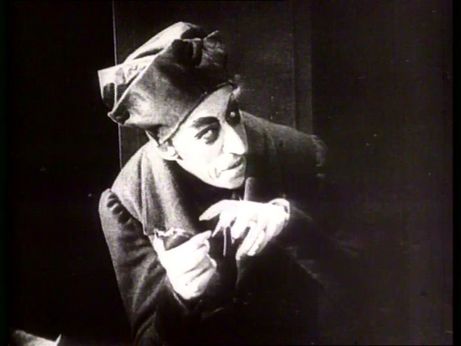
As many have pointed out, Murnau’s version of “Dracula”, a.k.a. the repulsive Count Orlok, possesses many physical features commonly found in stereotypical caricatures of Jews at the time: A long hooked nose, long claw-like fingernails, bushy eyebrows, a large forehead with bald head, and a general feminization of his appearance which was also common. His appearance is not only comparable to anti-semitic imagery, but he is also made to look something like a rat, in accordance with the disgusting rodents he brings with him. This, in turn, ties back into the Jewish stereotype, as Jews were often equated with rats as well.

Orlok brings filth and plague with him—not unlike prevalent fears regarding Eastern European immigrants. It’s worth noting that this attitude was not just a German one, but could be found in many Western nations, including the United States. He is an outsider, traveling West to literally infect and suck the country dry.

Medieval woodcut depicting the ritualized murder by bleeding of a
Christian child at the hands of Jews.
The parallels between vampirism and European anti-semitism go back much further than Nosferatu, and were in fact part of the continental zeitgeist for centuries. Jews—as well as gypsies, another popular scapegoat target of post-World War I Germany—were often depicted as bloodsuckers, and some have even traced the vampire’s aversion to Christian imagery to this parallel. There was also a popular myth that circulated for centuries regarding the alleged Jewish practice of drinking the blood of Christian children.

Compared to the native German Jew, the Eastern European Jew was seen as more of an alien influence, dissimilar in dress, language and appearance. Like Nosferatu—and notably unlike later cinematic vampires—they stood out blatantly from the rest of the populace. They were obviously, visually “other”. And the indigenous populace responded with paranoia over being overrun, of their nation being transformed or infected, as by a disease. They were seen as parasites.

Taking all this into account, it is reasonable to assume that Murnau knew very well that his audience would understand the symbolism and underlying message implicit in the Dracula story that informed Nosferatu. I do not by any means descry Nosferatu as a piece of pre-Hitlerian anti-semitic propaganda; however, I do find it obvious that there is an element of that way of thinking which informs the film throughout. It is not the entire message or point of the work, but it is a component.

Anti-semitism had been popular in Germany throughout the 19th century, and was magnified to the tenth degree under the influence of the Nazi party. Bridging the gap between those two eras was the time during which Nosferatu was made. It was a time during which commonly held prejudices were being congealed and codified into something far more sinister and institutionalized, and the influence of that time period on a film like Nosferatu is undeniable. It is a work of its time, designed in part to play on the fears of its target audience.

It was these festering fears, which boiled over during the Weimar years, which allowed Hitler and his ilk to get the populace on board with their plans for a return to German dominance, and to cleansing their Fatherland of the alien influence which had, they insisted, weakened it and brought it low. The Jew—along with the gypsy, the homosexual and any other element deemed a threat to the purity of the Aryan race—would be routed out in a Final Solution more horrifying than anything Murnau, Stoker or any other purveyor of fiction could have imagined.

While far from a work of pre-Nazi propaganda, and I would never characterize it as such, I can see the influence of these nascent strains of thought on the picture, both as a Jungian product of social subconscious and also, it must be said, through conscious intent. Yet these tropes inform much of early vampire literature and film, and I cannot discount their merit or their power as works of art on that basis. There is nothing wrong with enjoying Nosferatu—it is certainly a landmark film worth cherishing. But there’s also nothing wrong with remaining open to understanding the culture and social mindset from which it came.

Monday, January 9, 2012

Nosferatu at 90: Still the Greatest Vampire Film Ever Made

Greetings, and welcome to the first edition of a brand new year-long series here in The Vault of Horror. For me, dear readers, the year 2012 means only one thing--and that's the 90th anniversary of one of horror cinema's true unassailable classics, F.W. Murnau's Nosferatu. It's hard to fathom that this film is almost a century old, and even more impressive is its continued ability to shock and terrify no matter how much time passes. Just as I did in years past with A Nightmare on Elm Street, Psycho and An American Werewolf in London, I'll be posting throughout the next 12 months on this, the first and greatest of all Dracula adaptations.

How is it that this film still can effect us so profoundly, when so much of horror's power is drawn from the unexpected? One would think that age would be the death knell of a great horror movie, and yet films like Nosferatu prove this to be dead wrong. Whether you're discovering it for the first time all these decades later, or watching it for the 90th time, Nosferatu has the power to utterly creep you out. Personally, I credit it to the merits of German Expressionism.

And Murnau was undoubtedly one of the pioneers of this form of cinema, cutting edge for its time and a far cry from the American, Hollywood style that would soon dominate filmmaking in the years to come. Make no mistake, the silent era of film belonged to the Europeans, and the Germans, in particular, in addition to the Russians and the French, certainly left their mark. Like the best of his peers, Murnau achieved that defining goal of Expressionism in all its forms, namely to evoke pure emotion through the visual medium. Expressionistic works are in a sense dreams brought to life, and in the case of Nosferatu, that dream is most decidedly a nightmare.

The film oozes atmosphere from beginning to end, and is jam-packed with iconic imagery that has stood the test of time for a reason. Interestingly enough, it also set a standard for vampire films, and Dracula adaptations in particular, that was not really followed (at least not for many years). Nosferatu stands out on its own as a unique and truly cinematic retelling of the Dracula story, with liberal license taken, of course. It is vastly different from the Hamilton Deane and John Balderston play that would first be staged two years after its release--the version which inspired Universal's famous talkie version with Bela Lugosi at the start of the next decade.

Nosferatu chooses a different path, eschewing the nascent sex appeal of the vampire to take a more traditional, folkloric approach. The vampire here is still in his repulsive, pre-modern form--there is nothing at all sexy or alluring about Count Orlok (Unless you're into that sort of thing. Who am I to judge?) If anything, the vampire here is a metaphor for plague, and even possesses certain undeniable anti-Semitic overtones (but that's a post for another day).

Still, the story is undeniably Bram Stoker's. So much so that Stoker's widow and her crack legal team nearly had the film eradicated from the face of the earth (another post for a later day). Thankfully for film lovers everywhere, Ms. Stoker was not successful in her efforts, and the movie remains extant to this day for new generations of horror fans to discover and relish. There are many horror classics that stand the test of time, but few are as truly timeless as this one, defying changing filmmaking styles and changing filmgoing tastes to remain a favorite of genre fans. It is just as fresh now as it was when it emerged from a Germany still reeling from the First World War.

In addition to its Expressionistic roots, or perhaps in connection to them, I have always found that the film retains so much power largely because it is so visual in nature. Of course, this was very much necessary due to the limitations (or some might say advantages) of silent cinema, in that the visual was the easiest and most effective way to get your message across. Later versions of Dracula--and indeed horror films in general of the next couple of decades--would rely less on imagery and more on dialogue and cerebral scares. This is not to say that Nosferatu is not a psychologically frightening film, but I would submit that more of the terror it inspires is derived from the direct impact of what we see on screen. It is not so much suspenseful as it is downright terrifying to look at.

As has been the case throughout most of film history, America has been resistant to foreign films, and so this film did not even have a chance to be released here when it first was made in 1922. In fact, it wasn't until the 1960s, many years after a single surviving print had made its way to these shores in defiance of a court order, that it began to attain the cult following in the U.S. that it now enjoys. I have had the privilege of witnessing Nosferatu on the big screen with live musical accompaniment not once, but twice. And although I had my gripes with both viewings (an ironic, snarky crowd the first time out; and wholly inappropriate music the second time), I still consider myself fortunate to have had the experience.

At the time, Nosferatu was largely overshadowed by the Universal Dracula, and later the Hammer Dracula of the 1950s-70s, and yet its interesting to note that nowadays, most horror fans would place Max Schreck right alongside Bela Lugosi and Christopher Lee as one of the screen's iconic Counts. In fact, many vampire aficionados--including this one--will still argue that Nosferatu, the original vampire film, remains the very best to this day. A puzzling notion maybe, in that nobody has been able to top it in 90 years; and yet instead of bemoaning the state of vampire cinema for the past century, I will choose instead to celebrate the fact of Nosferatu's existence. And if it so pleases you, I invite you to join me in doing so for the remainder of 2012.

Sunday, June 26, 2011

A Trip Back in Time for NOSFERATU at Lyric Hall


There are a few horror films which have particularly shaped me into the fan that I am today. And on the short list of these would certainly be F.W. Murnau's Nosferatu, which has long been one of my favorites, and also among my picks for the most frightening motion pictures ever made. And this weekend, the Captain and myself were blessed with the opportunity to witness it as it was meant to be seen--on a big screen in a theater, with a live musical accompaniment.

I first discovered Nosferatu as a college student back in the early 1990s, having come across an old VHS copy at a street fair in Brooklyn. I'd heard a lot about it, but it wasn't until I saw it that I truly became mesmerized by this German Expressionistic masterpiece. I instantly became a champion for the film, publicly exhibiting it on my college campus during my time in the English Club (hey, it was based on Bram Stoker's novel, right?) and showing it to everyone I could. I even had a rare opportunity to head to Greenwich Village with some of my college pals to actually see the movie in a proper theater, with a live piano accompaniment. It seemed like a once-in-a-lifetime chance, but little did I know I'd have the chance to revisit it.

Fast-forward some 15 or so years later, and there we were, converging on New Haven's historic Lyric Hall for a unique exhibition of Nosferatu, this time with a live jazz ensemble accompaniment, no less. And it truly was a thrill to witness one of the most powerful horror films ever made, in such a way.

The venue alone made it worth the trip. Lyric Hall was an old vaudeville house going back a hundred years, and exactly the kind of intimate theatrical setting in which the movie might have originally been seen in 1922. Decorated with ornate chandeliers, elaborate moldings and gorgeous paintings, it was the ideal place to immerse oneself in such an experience. Sure, they were using a projection of the 2007 Kino DVD special edition release, but so what? That's the version with the remastered picture and restored tint, which only made it all the better.

The Lyric Hall Theater Orchestra, a small ensemble made up of guitar, tuba, accordion, saxophone, drums and assorted bizarre electronic noisemakers, put together an eccentric and engaging score for the film, which was especially effective during its more original portions. The droning, accordion-led music helped paint a nightmarish picture of dread that made me see the picture in a way I never had before.

That said, if I had to gripe about anything, it would be the noticeably inappropriate musical choices that peppered the score at periodic intervals. For instance, what would possess them to employ the theme to the movie Ben during the rats scene on the ship? Or "Happy Trails" as we watch Hutter gallop toward Count Orlock's castle? Or the Motown hit "Please Mr. Postman" at the moment he sends off his letter to his wife? While amusing, such post-modern, ironic touches only served to undermine the power of the film, and turn it into something to snicker at, rather than be terrified by. Much of the music actually worked against the film, which a good score should never do. Unless it was their intention to turn it into a comedy, which was not clear from the advertising at all.

Nevertheless, the music was, by and large, quite ingenious and suitably foreboding, in an unorthodox fashion. I can honestly say, that even after all these years, I've managed to see Nosferatu in a new light, taking away from it something I never did before. So you can imagine my delight when it was announced that in the fall, Lyric Hall will be presenting John Barrymore's 1920 Dr. Jekyll & Mr. Hyde. If only they can restrain themselves from the snarky musical interjections, that should be a lot of fun--and you can bet that the Captain and I will be on-hand with proverbial bells on.

Nosferatu has meant a lot to me through the years. I've shared it with close friends, with my children, and now, with my dear Captain Cruella. And I'm honored to have seen it not once, but twice on a big screen with live music. 2012 will mark the 90th anniversary of the film, and I'm already gearing up for a year-long celebration here in The Vault of Horror. So as I see it, this weekend's screening was the perfect warmup...

Monday, May 18, 2009

Why My Kids Are Cooler Than Yours

I was quite thrilled recently to finally get my hands on the ultimate 2-disc collector's edition of Nosferatu. It came out almost two years ago, but for one reason or another, I had only gotten around to snagging it now. I was looking forward to finally watching my favorite German Expressionistic horror film the way it was meant to be seen--original score, tinted frames and all. And of course, I was also looking forward to taking my kids along for the ride. Cause that's just how I roll.

My seven-year-old daughter, a budding vampire aficionado (I'm watching out for goth tendencies from now) was pretty damn psyched, and insisted we watch it together. Pretty sweet, right? Well, the catch is that she is still, after all, a seven-year-old girl, and on this particular night it just so happened that the allure of androgynous boys and painfully bad comedy on what passes for the Disney Channel these days was just too strong.

But that's what I have a son for, right?

I somehow managed to pry the boy away from his precious Nintendo Wii with the promise of monsters and mayhem. As dedicated as he is to the classic movie monsters, silent fare had proven to be a hurdle even he could not get over, what with his 21st century attention span and all. And yet, I had a feeling that the restored soundtrack and colored filters would provide just enough bells and whistles to keep his addled little brain in check.

And so, the boy, myself, and my dad sat down to enjoy F.W. Murnau's masterpiece--a trifecta of multi-generational horror fans doing what we do best. And it was indeed awesome for a time. The little dude sat in rapt attention as I melodramatically read the translated dialogue cards, and jumped at all the right moments: Count Orlock entering Hutter's room, stalking the deck of the ship, rising stiff as a board out of that coffin. That thrill that is my greatest reward every time I introduce him to a new horror flick.

But then, my poor darling girl, who must've heard us from her position upstairs soaking in the tween pablum that passes for young adult entertainment, stomped downstairs in a serious huff. The jig was up.

"You put on Nosferatu without me?" she asked incredulously, daggers in her big blue eyes...

I tried to explain to the girl that we owned this DVD and could watch it whenever we liked. That just because she didn't feel like watching it, didn't mean I couldn't. And of course, like a good daddy, that I would be happy to watch it with her from beginning to end tomorrow night. That seemed to allay some of the feelings of betrayal that had caused those tiny tears to well up.

And then it was time to put both of them to bed, which of course, led to a full-scale hissy fit on the part of the boy, who was just on the verge of witnessing Orlock making his iconic climb up the stairs to Ellen's bedroom for his final feasting.

Imagine that. A seven-year-old and a four-year-old vying passionately for the opportunity to watch Nosferatu. There may be hope for the future of America yet...

* Special thanks to BJ-C, who never seems to tire of reveling in the horrific exploits of me and my little ones... Hope you like!

Sunday, November 25, 2007

The Silent Dead: A History of Horror Movies, Part 1


For as long as humans have been sophisticated enough to desire entertainment, we've had an innate fascination with being horrified. Perhaps the last vestigal remants of the "fight or flight" instinct give us this visceral thrill, which we can enjoy freely with the knowledge that what we are seeing is not real.
As ingrained as the love of being scared is in the human psyche, it's suprising that horror took a while to establish itself as a major genre in the motion picture business. In the earliest days of the movies, they were not very common, particularly in America, where religious groups still held great sway over public opinion.
At the beginning of the industry, it was in Europe that horror films first took root. Pioneering French filmmaker Georges Melies (best known for 1902's A Trip to the Moon) is credited with creating the earliest examples with his two short films, The House of the Devil (1896) and The Cave of the Demons (1898).
At the start of the 20th century, the epicenter of the motion picture biz was in Germany, and horror pictures were no different. A wave of Expressionistic films emerged there in the '10s and '20s, the impact of which continues to be felt to this day. Chief among them were Paul Wegener's The Golem (1920), Robert Wiene's The Cabinet of Dr. Caligari (1920) and of course, F.W. Murnau's 1922 masterpiece, Nosferatu--the first of countless Dracula adaptations.
Meanwhile, in the States, it was actually Thomas Edison, who had invented motion picture technology in the first place, whose production company put out what may be America's first horror movie and the first in another long tradition, 1910's short film Frankenstein.
In Hollywood, the 1920s produced the first horror movie megastar, the one and only Lon Chaney. Known as "The Man of a Thousand Faces," Chaney achieved notoriety in large part due to his uncanny ability to transform himself through make-up. Chief among his notable roles are The Monster (1925), lost film London After Midnight (1927) and his iconic turn in The Phantom of the Opera (1925), which gave rise to Universal's classic monster movie series the following decade.
The end of the 1920s saw the rise of a revolution in filmmaking thanks to arguably the greatest innovation the industry has ever seen: sound. The effects would be profound, and horror movies would lead the way.
Other major releases:Soon to come: Part 2 - Gods and Monsters

Monday, November 12, 2007

Nosferatu Rises Again on DVD

For many, it's not just the first great horror film, but still among the very finest of all time. And now, thanks to Kino International, it's finally getting the treatment it deserves.
In one week, the "Ultimate DVD Edition" of the 1922 F.W. Murnau masterpiece Nosferatu: A Symphony of Horror will be released. A startling example of film restoration, the movie has been brought as close to its original grandeur as is humanly possible, including the original color tinting and a re-recording of the original score.
The edition also boasts:
  • The original German intertitles, plus the option for either newly translated English intertitles or subtitles.
  • "The Language of Shadows", a making-of documentary.
  • A short documentary on the restoration, which can be watched in its entirety here.
  • Lengthy excerpts from other Murnau films.

Basically, this thing is a treasure trove for any serious horror fan, so much so that I may even dust off the ol' wallet to spring for it, despite already owning an earlier edition. You can pre-order it here.

Related Posts Plugin for WordPress, Blogger...