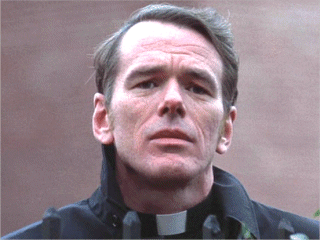
With the 40th anniversary of what is arguably considered the most frightening horror film of all time--and unarguably the most financially successful--my intention has been to celebrate that milestone all year. Much like I did with the 25th anniversary of A Nightmare on Elm Street in 2009, the 50th anniversary of Psycho in 2010, the 30th anniversary of An American Werewolf in London in 2011 and the 90th anniversary of Nosferatu in 2012. Alas, my schedule has made this more difficult than I originally planned, but at long last I'm able to sit down and put together the first of my "Exorcist XL" series, commemorating 40 years since the release of the first horror film to be nominated for Best Picture...
Growing up as a Roman Catholic, The Exorcist was a film that has filled me with dread for as long as I can remember. On the sidebar of this very blog, I recount the traumatic experience of first being exposed to it at the tender age of 8. It was a film that had an aura of the forbidden, and seemed in many ways to be the literal embodiment of evil. However, over time, I've come to the conclusion that--far from the unholy terror it has often been portrayed to be--The Exorcist is actually a very pious work. In fact, I'd go so far as to call it pro-Catholic propaganda. And that's coming from someone with the utmost admiration for the film.
I've heard religious individuals condemn The Exorcist as being the work of the Devil, and of being an immoral and irresponsible movie that devout Christians should avoid at all costs. Never mind the fact that, to my knowledge, the Roman Catholic Church (nor any major religious group, for that matter) never came out openly against the film in any way. In fact, the film even had the full participation of the Jesuit order, and even lent one of their brethren, Fr. William O'Malley (a licensed exorcist) to not only consult on the film, but to even appear on camera as the character Fr. Dyer, close friend of Damien Karras.
Why would this be the case, if The Exorcist were in fact a Satanic, anti-Catholic movie? If anything, it is quite the opposite. Within the world of The Exorcist, the priests are the good guys--they are soldiers of Christ. In fact, the movie is almost medieval in its thinking, casting the scientists as misguided, ineffectual and even actively negligent in their inability to help Regan during her plight. God and the Devil are quite real here, and only the disciples of God can be of assistance. Von Sydow's Fr. Merrin knows this to be true, and calmly dismisses more secular approaches.
One can even go so far as to interpret Regan's possession as a punishment for her mother's atheism--a belief system that in the world of this film leaves her without the ability to protect her daughter in any way. Chris MacNeil must go on a journey that forces her to confront the existence of traditional spirituality--much like Fr. Karras must struggle with his own loss of faith. It is only when Karras abandons his nihilism and embraces the empathetic virtue of self-sacrifice that he is finally able to find a true solution that separates Regan and the demon (although one can argue his selflessness is not necessarily religious but simply humanist in nature.)
Those who choose to avoid The Exorcist because they consider themselves good Catholics are missing the whole point. The movie may portray things that are considered hideous and obscene sacrilege, but these are depicted solely to demonstrate the work of the Devil in all its explicit evil. The movie does not take the demon's side--if anything, it is the men of God whom we are most encouraged to root for. Regan's revolting words and actions are shown simply to make the defeat of the demon that much more satisfying. And there is nothing seen that cannot also be found in actual reports of exorcisms performed by Catholic priests. I do not believe the film glorifies these elements, but rather uses them to establish the significance of the threat.
In short, the world of The Exorcist postulates that God and the Devil exist, that radical good and evil also exist, and that Christian spirituality is better equipped to combat evil than man's 20th century secularism. In other words, it is an extremely traditional film in theme and philosophy, and not the sordid, blasphemous work its opponents have often characterized it to be. In fact, I'd go so far as to speculate that the film can be interpreted as alarmingly archaic in its traditionalism, eschewing modern humanistic developments for a very black-and-white, fire-and-brimstone Old Testament version of reality. Far from being a Satanic work, it could easily have been based on an ancient or medieval fable, intended to keep potential stray believers on the straight and narrow.
The Exorcist may make the Devil seem cool, but don't forget that in the end the Devil loses--and it's the power of Christ that compels him.
Pages
"QUITE SIMPLY, THE BEST HORROR-THEMED BLOG ON THE NET." -- Joe Maddrey, Nightmares in Red White & Blue
**Find The Vault of Horror on Facebook and Twitter, or download the new mobile app!**
**Check out my other blogs, Standard of the Day, Proof of a Benevolent God and Lots of Pulp!**
Showing posts with label book adaptation. Show all posts
Wednesday, July 24, 2013
Friday, September 7, 2012
Nosferatu at 90: Florence Stoker, Vampire Hunter
The year is 1912. Bram Stoker, author of Dracula, has passed away. Some attribute the cause to syphilis. Left behind is his beautiful wife, Florence Anne Lemon Stoker, née Balcombe, a demure and striking stage actress when she married the Irish theatrical agent in 1878 at the age of 20. Now a widow in her 50s, with one grown son starting a family of his own, Florence finds herself struggling financially--a sad burden compounded no doubt by the rumors surrounding her husband's death. Ironically, the one thing that remained to her as far as financial means was the copyright to her late husband's famous vampire novel.
Fast forward a decade. A relatively new entertainment medium, cinema, is finally hitting its full stride and one of the epicenters of the explosion is Germany, where an Expressionist movement is taking the country by storm. A small art collective known as Prana Films, spearheaded by artist and spiritualist Albin Grau, produces a vampire film called Nosferatu, Eine Symphonie des Grauens, whose screenplay, penned by Henrik Galeen, has taken for its direct inspiration Stoker's Dracula. However, to avoid having to pay anything for intellectual rights, Prana Films never seeks permission from Florence Stoker, still alive and well in Britain. The names and places in the silent film are all changed from the novel in a naive attempt to avoid infringement. Count Dracula becomes Count Orlock.
On March 4, 1922, Nosferatu enjoys a lavish premiere at Marble Hall of the Berlin Zoological Gardens, complete with live musical accompaniment and sound effects. The following month, Florence Stoker receives an anonymous letter from Berlin, containing a program from the premiere. The program directly states that Nosferatu has been "freely adapted from Bram Stoker's Dracula". Having received no permission requests, nor even being aware of the film's existence up to this point, the 62-year-old widow, still depending on whatever income she can get from the novel's copyright, is outraged.
What follows is a one-woman crusade the likes of which has never been seen in film history, before or since. Represented by the British Incorporated Society of Authors, Florence Stoker, as literary executor for the estate of her late husband, files a sweeping lawsuit against Prana Films which calls not only for financial compensation for the use of her intellectual property, but also the complete and total destruction of the film itself.
The legal battle would rage for over three years. Prana Films declared bankruptcy due to legal costs, and also in an attempt to avoid making payments to Mrs. Stoker. Meanwhile, the company's lone production, Nosferatu, continued to play throughout Germany and Hungary, but nowhere else, its international distribution halted by the litigious ruckus. Ironically, the success of the film in its homeland had made Stoker's copyright even more valuable than before. Prana would even try to make a deal with her, offering to cut her in on the film's profits if she would allow them to expand the release and use the Dracula name. She refused, insisting again on the torching of the film.
While the suit took its course, Stoker was simultaneously negotiating with producer and Dublin neighbor Hamilton Deane, who sought to bring the novel to the stage. His officially licensed theatrical production of Dracula would premiere in Derby in 1924. It was an immediate hit, and its success helped boost the fortunes of Florence Stoker, who was also on the verge of winning her lawsuit with the doomed Prana Films.
In July 1925, the court ruled that Prana Films was in direct copyright infringement of the intellectual property of Florence Stoker. Financial reparations were ordered, but the failed company was unable to pay. The court also ordered that the negative of Nosferatu, as well as all known prints, be rounded up and promptly destroyed--the only known case of a "capital punishment" ruling on a major motion picture. It would be the only movie ever made by Prana, and had not been seen by anyone outside of Germany and Hungary--including Florence Stoker.
With Nosferatu seemingly destroyed, Stoker continued to reap the rewards of Deane's official stage adaptation. In fact, she granted the American stage rights to producer Horace Liveright in 1927 and Liveright hired John L. Balderston to adapt the play for U.S. audiences. It premiered on Broadway with virtually unknown Hungarian actor (had he seen Nosferatu during its release?) Bela Lugosi as Count Dracula, and ran for a year on Broadway and two more on tour. However, in another case of intellectual property shenanigans, it turned out that Bram Stoker had never properly seen to the U.S. rights for his novel, and so it was in the public domain. This meant that Florence Stoker never received her full payment for the American production from Liveright, who was no longer even alive by the end of the play's run.
Meanwhile, it turned out that much like a vampire itself, Nosferatu the film was not exactly dead. Somehow, there were prints that survived the court-ordered obliteration. One of these made it to America in 1929, and it was then that the film finally made its US debut, against Stoker's direct wishes, screening in New York and Detroit. And when budding Hollywood movie studio Universal, nearly a decade after the film's release, sought to make their own talkie adaptation of Dracula based on the stage play, they also studied Nosferatu closely, and the influence can be seen in their 1931 film version, also starring Lugosi.
Florence Anne Lemon Balcombe Stoker died in London on May 25, 1937 at the age of 78, survived by her son Irving Noel, granddaughter Ann Elizabeth, and newborn great-grandson Richard Noel. In her later years, she no doubt enjoyed greater financial prosperity thanks to the stage production of Dracula, as well as other licensed properties like Universal's film and it's 1936 sequel, Dracula's Daughter. It's unknown whether she was aware of Nosferatu's survival, or how she felt about it if she did know.
The film remained an obscurity for decades, playing here and there, but never being fully embraced by audiences. It finally reached a wider audience in the 1960s, when it found its way to late-night television, along with whatever other public domain films were available at the time. Renewed interest in the film finally led to the resurfacing in 1984 of a complete print--the first found since its attempted destruction nearly 60 years prior. The uncut version played at Berlin's Film Festival that year, a stone's throw from where it had debuted in 1922. Free at last from the shadow of Florence Stoker's wrath, Nosferatu took its rightful place as the seminal vampire film that it is. It was released to home video for the first time in 1992, and the 2007 DVD release is the very first home video version to include the original music, all original scenes, plus the original color film tints.
Whatever its merits, justification, or lack thereof, Florence Stoker's crusade had failed in the end. Nosferatu the film, in true Dracula fashion, could not be completely destroyed. And it's thankful for us that it wasn't--for as horror scholar David J. Skal wrote in his 1990 book Hollywood Gothic: The Tangled Web of Dracula from Novel to Stage to Screen, "Nosferatu mined Dracula's metaphors and focused its meaning into visual poetry. It had achieved for the material what Florence Stoker herself would never achieve: artistic legitimacy."
Fast forward a decade. A relatively new entertainment medium, cinema, is finally hitting its full stride and one of the epicenters of the explosion is Germany, where an Expressionist movement is taking the country by storm. A small art collective known as Prana Films, spearheaded by artist and spiritualist Albin Grau, produces a vampire film called Nosferatu, Eine Symphonie des Grauens, whose screenplay, penned by Henrik Galeen, has taken for its direct inspiration Stoker's Dracula. However, to avoid having to pay anything for intellectual rights, Prana Films never seeks permission from Florence Stoker, still alive and well in Britain. The names and places in the silent film are all changed from the novel in a naive attempt to avoid infringement. Count Dracula becomes Count Orlock.
![]() | |||
| Florence Balcombe, sketched by her former love interest, Oscar Wilde. |
What follows is a one-woman crusade the likes of which has never been seen in film history, before or since. Represented by the British Incorporated Society of Authors, Florence Stoker, as literary executor for the estate of her late husband, files a sweeping lawsuit against Prana Films which calls not only for financial compensation for the use of her intellectual property, but also the complete and total destruction of the film itself.
The legal battle would rage for over three years. Prana Films declared bankruptcy due to legal costs, and also in an attempt to avoid making payments to Mrs. Stoker. Meanwhile, the company's lone production, Nosferatu, continued to play throughout Germany and Hungary, but nowhere else, its international distribution halted by the litigious ruckus. Ironically, the success of the film in its homeland had made Stoker's copyright even more valuable than before. Prana would even try to make a deal with her, offering to cut her in on the film's profits if she would allow them to expand the release and use the Dracula name. She refused, insisting again on the torching of the film.
![]() |
| Hamilton Deane |
In July 1925, the court ruled that Prana Films was in direct copyright infringement of the intellectual property of Florence Stoker. Financial reparations were ordered, but the failed company was unable to pay. The court also ordered that the negative of Nosferatu, as well as all known prints, be rounded up and promptly destroyed--the only known case of a "capital punishment" ruling on a major motion picture. It would be the only movie ever made by Prana, and had not been seen by anyone outside of Germany and Hungary--including Florence Stoker.
With Nosferatu seemingly destroyed, Stoker continued to reap the rewards of Deane's official stage adaptation. In fact, she granted the American stage rights to producer Horace Liveright in 1927 and Liveright hired John L. Balderston to adapt the play for U.S. audiences. It premiered on Broadway with virtually unknown Hungarian actor (had he seen Nosferatu during its release?) Bela Lugosi as Count Dracula, and ran for a year on Broadway and two more on tour. However, in another case of intellectual property shenanigans, it turned out that Bram Stoker had never properly seen to the U.S. rights for his novel, and so it was in the public domain. This meant that Florence Stoker never received her full payment for the American production from Liveright, who was no longer even alive by the end of the play's run.
Meanwhile, it turned out that much like a vampire itself, Nosferatu the film was not exactly dead. Somehow, there were prints that survived the court-ordered obliteration. One of these made it to America in 1929, and it was then that the film finally made its US debut, against Stoker's direct wishes, screening in New York and Detroit. And when budding Hollywood movie studio Universal, nearly a decade after the film's release, sought to make their own talkie adaptation of Dracula based on the stage play, they also studied Nosferatu closely, and the influence can be seen in their 1931 film version, also starring Lugosi.
Florence Anne Lemon Balcombe Stoker died in London on May 25, 1937 at the age of 78, survived by her son Irving Noel, granddaughter Ann Elizabeth, and newborn great-grandson Richard Noel. In her later years, she no doubt enjoyed greater financial prosperity thanks to the stage production of Dracula, as well as other licensed properties like Universal's film and it's 1936 sequel, Dracula's Daughter. It's unknown whether she was aware of Nosferatu's survival, or how she felt about it if she did know.
The film remained an obscurity for decades, playing here and there, but never being fully embraced by audiences. It finally reached a wider audience in the 1960s, when it found its way to late-night television, along with whatever other public domain films were available at the time. Renewed interest in the film finally led to the resurfacing in 1984 of a complete print--the first found since its attempted destruction nearly 60 years prior. The uncut version played at Berlin's Film Festival that year, a stone's throw from where it had debuted in 1922. Free at last from the shadow of Florence Stoker's wrath, Nosferatu took its rightful place as the seminal vampire film that it is. It was released to home video for the first time in 1992, and the 2007 DVD release is the very first home video version to include the original music, all original scenes, plus the original color film tints.
![]() |
| Florence Stoker and son Noel, circa 1882. |
Wednesday, May 19, 2010
Basterd's Fassbender Joins Screen Adaptation of A Single Shot
By Paige MacGregorAlthough he had an extensive career in British film and television prior to his role in Quentin Tarantino’s Inglourious Basterds, actor Michael Fassbender gained a significant foothold in American cinema after his performance in Tarantino’s most recent release. Now Fassbender joins actors William H. Macy and Thomas Haden Church in David Jacobson’s adaptation of Matthew F. Jones’ thriller novel A Single Shot, as was first reported Monday by Screen Daily.
Fassbender, whose horror experience includes the 2008 British thriller Eden Lake and 2009 horror drama Blood Creek, is an ideal candidate to play the protagonist from Jones’ novel, a poacher named John Moon. A Single Shot follows Moon through an unfortunate series of events; after accidentally killing a runaway girl while deer hunting, Moon finds evidence that the girl may not have been alone. After uncovering a large sum of money, Moon ends up on the run from a group of hardened killers with a suitcase full of money and a bull’s-eye on his head.
The novel’s action takes place over the course of seven days, and readers watch as Moon spirals deeper and deeper into a psychological meltdown in an attempt to evade his pursuers. The role of John Moon is thus a demanding one, and it is probably safe to assume that a great deal of the movie’s action will revolve around his character. For these reasons, Michael Fassbender is a perfect choice for the role given the intensity and diversity that he can portray onscreen.
Filming for A Single Shot will begin this summer, presumably after Fassbender finishes with David Cronenberg’s A Dangerous Method (Viggo Mortensen, Kiera Knightley, and Vincent Cassell). For more information on Michael Fassbender, visit the actor’s official IMDb page. For details on Jones’ novel, A Single Shot, you can visit the novel’s page on Amazon.com.
Tuesday, May 4, 2010
"Heck" Adapted for the Silver Screen
By Paige MacGregorThe film will be adapted for the screen by Spyglass Entertainment, the production company behind other kid-friendly features such as Stick It, 27 Dresses and The Pacifier. The story will follow Milton and his sister to Heck, where they meet a boy named Virgil who has a map of the Nine Circles of Heck. Together, the youngsters plan their escape from the underworld and the principal of Heck, Bea “Elsa” Bubb.
According to Spyglass Entertainment reps, the company wants the Heck adaptation to be a big, “effects-driven family adventure in the vein of Beetlejuice”, the popular 1988 horror comedy starring Michael Keaton, Geena Davis, Alec Baldwin and Winona Ryder. Director Juan Jose Campanella (whose foreign-language film, The Secret in Their Eyes, took home the Oscar this year) is set to direct the Heck adaptation. Reportedly, Campanella’s work is a testament to his dark side—along with an obsession with the color red—that seems to hold great potential for a film like Heck.I don’t know a lot about Juan Jose Campanella—although I plan to take a look at his recent Oscar-winning film in the very near future—but I’m still very excited about this cinematic adaptation. Not to mention the outrage and anger that will be incited among parents who say that the film glorifies death or some other ridiculous thing.
For more information on Dale E. Basye’s book series, head over to the series’ official Web site. The film project is currently in development, so unless you have an IMDbPro account you won’t find much on the IMDb site, but we’ll keep our eyes peeled for updates on the film and an official web site.
Friday, April 30, 2010
New Drool-Worthy Jonah Hex Trailer and One-Sheet...

By Paige MacGregor
Revenge may get ugly, but apparently it also gets sexy. A new Jonah Hex one-sheet that features Michael Fassbender, John Malkovich, Josh Brolin and Megan Fox (left to right, above) was released this week, and I must admit that this is the first time I’ve been more than a little bit excited about the film (based on the classic horror/western DC comic of the '70s and early '80s.) Although Malkovitch is a little old for me, there’s no denying that he’s a very entertaining actor, and the fact that he joins seductive leading lady Fox, delectable indie actor Fassbender, and the (usually) ruggedly handsome Josh Brolin (all scarred up to play Hex) is enough to make my head explode.
Granted, I’m not expecting a great deal from Jonah Hex; it’s received very little press as compared to many of the other horror/thrillers coming out this year (A Nightmare on Elm Street, etc.) and chances are it will be a disappointment at the box office (its June 18 release date pits it against the highly anticipated Toy Story 3). But any opportunity to ogle both Fox and Fassbender during the same film is a-okay by me.
The trailer for Jonah Hex was also released on Yahoo yesterday, and I just have to point out that within just the first twenty seconds, we get more than an eyeful of Fassbender’s character, Burke. The 2:30 trailer promises guns, girls (well, a girl, but Megan Fox is worth more than one girl, in my opinion) and explosions—just what every action audience could ask for. While the one-sheet re-energized my excitement in the film, the Jonah Hex trailer has me on the edge of my seat with anticipation over Michael Fassbender’s performance. Aside from John Malkovitch (maybe), Fassbender can act circles around the film’s other leads.
My guess as to who will enjoy Jonah Hex? People like me, who will go to the theater just to watch a gun-wielding Megan Fox prance around in a bustier on the big screen. Also, Michael Fassbender fans who are excited to see the actor--generally consigned to indie films--in his second recent mainstream movie (the last being Quentin Tarantino's Inglourious Basterds). While we can’t predict whether Jonah Hex will be a “good” movie, it’s sure to be at least be entertaining--and probably a bit titillating.
Wednesday, April 14, 2010
Hump-Day Harangue: Walking Dead Cast Takes Shape...
Not really much of a literal "harangue" this week, if you must know the truth--more of a cautiously optimistic nod of approval, as the anxiously anticipated AMC series adaptation of Robert Kirkman's The Walking Dead comic book series becomes more and more of a reality.Yesterday, rumors of Brandon Routh being cast in the show were debunked by the actor himself. I'll admit, I couldn't quite figure out who he was going to be playing anyway, especially since two of the prime roles had already been cast.
Speaking of those two roles, it's very interesting to see that AMC is going with relative unknowns for the most part in this, its first wholly owned TV property. The basic cable channel has been on fire lately with shows like Breaking Bad and Mad Men (my personal fave on TV right now), inheriting the throne of TV excellence once firmly inhabited by HBO. And those are both shows which have benefited greatly from having some fresh faces in key parts, so it's understandable that AMC would continue the trend.
As is our wont, we geeky internet types had a ball speculating as to which recognizable actor could take on this or that role. I know I recently conducted a poll which asked who should play lead character Rick Grimes, with choices like Lost's Josh Holloway, Supernatural's Jared Padalecki and Parenthood's Peter Krause (my choice at the time.) In the end, AMC went with British actor Andrew Lincoln (pictured), perhaps best "known" for his supporting part in the 2003 ensemble pic Love Actually. Playing his cop buddy Shane will be Jon Bernthal, an even less known commodity whom I mainly recall from his part as Al Capone in the sequel to A Night at the Museum (hey, I have kids, it comes with the job.)In the end, I have to give kudos to AMC for resisting the allure of "name-brand" actors, although I'm sure the lower price-tags may have been a crucial factor in the decision, as well. Much like Mad Men, this is the kind of a show that will benefit greatly from a cast of relatively unrecognized talent (although it should be said that Lincoln is fairly known in the UK for his television work.) This shouldn't be something like a CSI or Law and Order spin-off, packed with familiar faces and big-time movie stars slummin' on TV. One of the selling points of The Walking Dead is its dedication to presenting a "believable" zombie apocalypse, as much of an oxymoron as that may be, and the presence of famous celebs would no doubt be a bit distracting.
Kirkman himself seems to be excited, although if I were in his shoes I'd be excited if they had cast Jerry Stiller and Fyvush Finkel in the leads. Nevertheless, I think The Walking Dead has lots of potential to be something very special, and as location scouting kicks off and shooting is almost ready to begin, I gleefully await the realization on screen of one of the strongest comic book series I've read this decade.
Friday, February 5, 2010
Psycho Semi-Centennial: The Man Behind the Madman
Were it not for H.P. Lovecraft, Psycho might never have come into existence. Yes, despite Lovecraft's brand of horror being the complete opposite of what Psycho represents, the godfather of the weird and supernatural can take some credit for it's existence. This is due to his mentoring of the man who wrote the novel on which the film was based: Robert Bloch.
In the early 1930s, the teenaged Robert Bloch was an avid reader of the venerable horror pulp Weird Tales, and Howard Phillips Lovecraft was his favorite contributor by far. The youngster began a letter correspondence with the legendary author, who would later encourage his own burgeoning writing efforts. HPL even featured his enthusiastic fan as a character ("Robert Blake") in his short story "The Haunter of the Dark" (he killed him off in it.) And when Bloch made his first fiction sales at the age of 17 ("The Feast in the Abbey" and "The Secret in the Tomb"), they were to Weird Tales, where his work could appear alongside that of his idol.
By the time Lovecraft passed away in 1937, his young protege was well on the way to succeeding him as America's most gifted horror storyteller. At first, his stuff was heavily Lovecraftian in tone. Yet much later, his most famous work would be nothing like anything Lovecraft would've ever put to paper.Robert Albert Bloch was born April 5, 1917 in Chicago, Illinois, the son of bank cashier Ray Bloch and his wife Stella Loeb, a social worker. He took to reading tales of the bizarre and fantastic from a young age, and soon began writing some on his own. Genre fiction would always be his great love, and his immense body of work would eventually come to include sci-fi, horror, mystery and crime.
Following Lovecraft's death, Bloch continued writing for Weird Tales, and also started contributing to lots of other pulps, including Amazing Stories. He wrote several tales within Lovecraft's own Cthulhu Mythos. Yet by the 1940s, he had begun experimenting with a different kind of horror from that of his mentor, weaving in elements of crime fiction to create a series of stories based on the cases of Jack the Ripper, the Marquis de Sade, Lizzie Borden and others.
As his career blossomed in the 1950s, Bloch became a major force in the world of genre fandom as it then existed. He was a prolific writer, authoring 29 novels (beginning with 1946's The Scarf) and countless short stories that appeared in magazines and anthologies. He would eventually capture the Hugo award, the Bram Stoker award and the World Fantasy award for his writing, and serve as president of the Mystery Writers of America.Bloch also branched out into the world of filmed entertainment, crafting screenplays and contributing stories that would be used on TV and in the movies. He wrote scripts for the Boris Karloff-hosted horror TV anthology Thriller, and penned the scripts for the classic Star Trek episodes "Catspaw", "What Are Little Girls Made Of?" and "Wolf in the Fold" (which dealt with Jack the Ripper). His stories also inspired movies like William Castle's The Night Walker (1964), Strait-Jacket (1964), The House That Dripped Blood (1970) and Asylum (1972).
Yet it would be Bloch's first adapted story that would become by far his most famous, and forever enshrine him in the pantheon of iconic horror wordsmiths. It began as a kernel of an idea in his 1957 short story "The Really Bad Friend", which appeared in the pages of Mike Shayne Mystery Magazine. Then, in 1959 he wrote the novel Psycho, based loosely on the real-life case of another famous murderer, Ed Gein.Psycho was the ultimate development of the approach Bloch had been developing for over a decade. It was a different kind of horror story, taking place in modern urban and suburban settings, with contemporary characters, and dealing with situations based in reality, instead of the supernatural. Yet this was no crime or detective story, as previous tales of this type had been--Psycho was a horror novel, of a very different kind.
And just as it was a landmark in horror fiction, it would be adapted in 1960 by screenwriter Joseph Stefano into something that would have just as groundbreaking an effect on horror film, if not even more so. As directed by Alfred Hitchcock, Bloch's novel became one of the most well-known horror stories of all time, and his character Norman Bates--though very different from the character as presented by Bloch--would be immortalized as horror's first thoroughly modern movie "monster", and the prototype of the movie slasher.
Bloch enjoyed great notoriety from the success of Psycho, and his profile in the world of horror fandom was certainly raised to dizzying heights. He would take part in the founding of the Horror Writers Association (HWA) of America. He continued writing prolifically, evening penning two sequel novels to Psycho (unrelated to the movie sequels) in 1982 and 1990.In 1994, the 35th anniversary edition of the novel Psycho was published--a run of merely 500 copies, all autographed by Bloch. Mere months later, on September 23, 1994 Robert Bloch passed away in Los Angeles, California at the age of 77.
Just as his mentor had done some 30 years earlier with his stories in Weird Tales, so did Bloch revolutionize the horror genre with Psycho. For all his vast body of work, Robert Bloch will forever be identified by far with his 1959 novel, and rightfully so. It stands with the likes of The Maltese Falcon, Lord of the Rings and 1984 as one of the 20th century's most important genre novels.
Friday, January 15, 2010
What Am I Most Looking Forward to in 2010?
Yours truly was called upon by Iloz Zoc, fearless leader of the League of Tana Tea-Drinkers, to participate in the latest LoTT-D "Pick-a-Post" blog carnival. The question: What are you most looking forward to in 2010? Well, I thought long and hard about it, and lo and behold, it turns out that the one thing in horror I'm most looking forward to is not a movie, but a TV show. See, although there are some solid releases coming out in theaters this year, there isn't one single film I'm looking forward to more than the Walking Dead television series.When it was announced some months ago that AMC had picked up the property to be developed into a series, it was literally like a fanboy dream come true for me. I've had my issues with the original Image comic book by Robert Kirkman, but I had always wanted to see it on the small screen in series format. And I wasn't the only one--lots of fans of the book always liked to speculate as to how it would play out on TV. And now, after all the fantasizing, it's finally going to be a reality.
The zombie craze has been with us for some years now on the big screen, and now, at long last, those undead bastids are poised to invade our living rooms. How the hell did it take so long to happen? And while I'm sure there will be copycats galore--MTV is already developing a Dawn of the Dead TV series (*douche chills*)--I have no doubt the Walking Dead project will trump all.This is for a few reasons. One is that AMC is developing it. Now, I had always felt The Walking Dead would be tailor-made for HBO, and I still feel that premium cable is really the ideal place for this material. But AMC has proven itself to be serious about good television, what with Mad Men and Breaking Bad. While the gore quotient will probably suffer a little bit compared to what it could've been on HBO, I don't have much problem with that--partly because the quality of the show is what's most important, and partly because the gore was never a huge part of the original book to begin with.
As I said, I've had issues with Kirkman's series, and i actually no longer read it. Haven't in years. But I was there at the very beginning, back in the summer of 2005, when the book debuted, and I continued reading it for the first three years. I was eventually driven away thanks to sub-par artwork (which is a non-issue for the TV show), as well as by Kirkman's meandering, often-dull and remarkably zombie-less narrative.But those early years were often quite good, and I'm hoping that's what the TV show will be drawing on. Once Kirkman got so pretentiously caught up in the day-to-day soap opera turmoil of his human characters, I lost interest. He seemed to be killing time with each issue; filling space. And while some have told me the story plays out better when read in collected form, I couldn't help but be driven away by a terrific premise that seemed to be eventually squandered.
But I don't see this happening with the show. In fact, I see the show exceeding the comic book. We have the brilliant Frank Darabont on board as producer, bringing his keen eye for genre entertainment and compelling drama to bear. We also have one hell of a great concept. So great, it's amazing it's never been done before--a weekly ongoing series following human survivors as they make their way through the zombie apocalypse. Think of every zombie movie you ever saw in which the story just ends and we never find out what happens to our remaining surviving protagonists. Well this time, the story will continue--we will get to see how they get by, how they live their lives in the midst of hell on earth.
There hasn't been much talk of casting, although I have heard fans clamoring for Josh Holloway (a.k.a. Sawyer from Lost) to play the lead part of police officer Rick Grimes, and I have to say he would indeed be a fine choice.The Walking Dead TV series was, until a few months ago, the subject of fan fantasy, the ultimate wish of hardcore zombie-heads. It always seemed to make perfect sense to do it, but for some reason, no one seemed interested. That's now changed. And I'll be anxiously waiting for Rick and the zombies to join Don Draper and the gang at Sterling Cooper in giving me reasons to tune in to AMC in 2010.
Thursday, November 5, 2009
Retro Review: The Body Snatcher (1945)
Every now and then, the horror gods smile down, the planets come into alignment, and a project like this one comes to be. As horror fans, we are very lucky to have such a remarkable film which, thanks to the miracle of home video, we can see pretty much any time we want.Let's break it down, shall we? The original story comes from a work by Robert Louis Stevenson, author of The Strange Case of Dr. Jekyll & Mr. Hyde. Stevenson apparently based it upon true reports of grave robbers on a spree throughout England and Scotland.
Producing the film version is the one and only Val Lewton, the visionary filmmaker responsible for the finest horror highlights of the 1940s. More than any other producer, Lewton is cited as having a tangible, almost directorial influence on his movies. This is simply one of a string of classics Lewton brought to fruition, including I Walked with a Zombie, Cat People, and The Seventh Victim.
Nevertheless, Lewton did employ a director, and a formidable one, at that. The great Robert Wise cut his teeth as a cinematographer for Orson Welles, but it was Lewton who first gave him a chance to direct--this was the third film Wise helmed for him. Wise, of course, would go on to direct such films as The Day the Earth Stood Still, Somebody Up There Likes Me, West Side Story, The Haunting, The Sound of Music, The Andromeda Strain and Star Trek: The Motion Picture. Not a bad resume, yes?Taking center stage in this lurid tale of the dark side of the early medical profession is a group of actors whose talents would have been renowned whether or not they had ever chosen to appear in a single horror film. Firstly, it should be pointed out that this movie would mark the final on-screen teaming Boris Karloff and Bela Lugosi--although Lugosi, already down on his luck and relegated to low-budget Monogram clunkers, played merely a supporting role while Karloff starred.
Fresh off his sinister turn as Dr. Neimann in his last Universal horror flick, House of Frankenstein, Karloff takes to the role of the titular body snatcher John Gray with particular relish. This would be the first of three consecutive Lewton flicks for Karloff, followed quickly by Isle of the Dead and Bedlam. It's debatable, but this may be the best of the three.Playing alongside Karloff is one of classic Hollywood's true unsung heroes, Henry Daniell--a stage-trained British actor who might best be known for playing alongside Charles Laughton in the flawless legal dramedy Witness for the Prosecution. Usually relegated to supporting parts, Daniell appeared with Greta Garbo in Camille; with Charles Chaplin in The Great Dictator; with James Stewart, Kate Hepburn and Cary Grant in The Philadelphia Story; with Kirk Douglas and Anthony Quinn in Lust for Life; and with Ava Gardner and Errol Flynn in The Sun Also Rises.
But this time out, Daniell takes the lead, playing the tragic role of Dr. "Toddy" McFarlane, a famous surgeon with a sordid past tied to the insidious grave robber and murderer Gray. The interplay between the two is gripping at all times, and their antagonistic yet strangely symbiotic relationship is at the heart of the picture. And the climax, for those who may not have seen it, is one of the most underrated cinematic triumphs of psychological horror ever. Absolutely chilling, in that Victorian-era-horror-yarn kind of way.As with all Lewton films, much of the power here is also the result of the tremendously dark and foreboding look and feel. No doubt having an eye for good camera work himself, given his background, Wise uses as his cinematographer the accomplished Robert De Grasse, who had previously done The Leopard Man for Lewton, as well as the gorgeous Fred Astaire/Ginger Rogers musical The Story of Vernon and Irene Castle.
And helping create the look of musty crypts, creepy graveyards and creaky 19th century medical laboratories is the amazing art director Albert S. D'Agostino--whose impressive horror credits include the Lewton films of the '40s, '30s Universal flicks like Werewolf of London and Dracula's Daughter, and '50s gem The Thing from Another World. There's a reason I picked his name to affix to the Cyber Horror Award for Best Art Direction!Put all these ingredients together, and you have what is easily one of the top five horror films of the 1940s. Stevenson. Lewton. Wise. Karloff. Lugosi. D'Agostino. Like I said, an alignment of the horror planets if ever there was one. Highly recommended.
Monday, October 12, 2009
Tuesday, September 15, 2009
See the New SOLOMON KANE Trailer Here!!
For my fellow Robert E. Howard lovers, here's a look at the brand new film about everyone's favorite 16th century Puritanic demon hunter, Solomon Kane. The flick, starring Rome's Jame Purefoy as the original ghostbuster, premieres tomorrow night at the Toronto International Film Festival. Enjoy!
Wednesday, August 19, 2009
Hump-Day Harangue: So, About This Walking Dead TV Series...
A couple days ago, the news tore through the online horror universe like crap through a goose. Robert Kirkman's acclaimed The Walking Dead comic book series has officially been optioned by AMC as a TV series to be directed by Frank Darabont. And let me just say, I'm very excited about it. But my excitement comes with certain caveats. Allow me to explain.I started reading The Walking Dead from the very first issue, back in 2003. That's right, I read the original monthly issues--none of that trade paperback or hardcover stuff for me. I was overjoyed to find an ongoing comic book series about a zombie apocalypse, and one that seemed to be smartly written, and amazingly drawn.
Speaking of drawn, I'll say that it was the stunning artwork by Tony Moore that helped take the book to a whole other level. Unfortunately, after only six issues, Moore abruptly departed. That was the first blow. He was replaced by Charlie Adlard, an artist I never warmed up to. I found his work to be sloppy, uninspired, and even confusing.
With Moore gone, my interest in the book began to wane. The shoddy artwork began to draw attention to the flaws in Kirkman's writing. The multitude of similar characters who became hopelessly impossible to distinguish from on another under Adlard's pen and brush. Then there was the snail's-pace plot development, which devolved into soap opera, in which whole issues would go by without a single zombie, let alone any action whatsoever.The book had great promise. On paper, it's an excellent concept: Charting the ongoing efforts of a group of survivors in a world overrun by the undead. Kind of like a great zombie movie that doesnt end after just two hours, but shows you what happens week after week, and month after month. But my problem was with the execution. The problem was, nothing much happened.
I remember an issue which ended with our heroes mistakenly wandering into a gated community swarming with ghouls. You'd think this would be fodder for a whole bunch of issues overflowing with zombie action, but Kirkman wraps it up in just one issue, then takes the characters to the shelter of an abandoned prison, where they remain seemingly forever, interacting solely with each other while the zombies remain harmlessly outside the gates.
Still, being the zombie lover that I am, I gave the book every chance. I stuck with it for three years, despite the fact that I started losing interest after only six months. But I finally had to give up.Through all that time, what kept me engaged was the great concept, which I knew, as other readers did, would make for a great television series. There had never been a zombie TV series, and certainly in this age of quality cable shows, the time was ripe. Naturally, most hoped for an eventual HBO run, since that seemed the most approptiate outlet.
And so now, years after I walked away from the book, ironically, comes the news that finally, The Walking Dead will indeed become a TV series. And despite my abandonment of the comic, I will admit that my interest has been greatly piqued, for a number of reasons.
Firstly, those early issues of the series are very strong, and will make for some killer episodes. Then, there's the Darabont factor. The man is a gifted director, with a head for genre material, and I have no doubt he can deliver a product that is actually superior to the material on which it's based.However, the show must avoid the pitfalls that doomed the book, in my eyes. To go an entire episode in which we completely forget that the world has been taken over by zombies would be disastrous, quite frankly. Kirkman made the rather pretentious claim at one point that the title referred not to the zombies, but to the human characters--and his readers rightly called him out on it within the book's copious fan letter pages. The writer eventually backed down and even admitted himself that it was a bit of a heavy-handed conceit, or at least one that George Romero had already exhaustively mined.
To be a success, this show needs to deliver the goods, and not become the boring soap that the book became. It also needs to work around the constraints of commercial TV. AMC has freer reign than broadcast networks, but its not as free as HBO or Showtime. But then again, this book isn't so much about the gore factor, anyway, so maybe that won't be much of a problem.
There are a lot of people excited about this project, and with good reason. But I wonder how many of them actually read the comic book, especially as long as I did. Sure, it is a great idea, and had moments of greatness, including the torture of Michonne at the hands of the Governor, or the stuff at Herschel's farmhouse... but for the most part, in my opinion, it fell far short of its potential. And I'm hoping this show won't do the same.
So don't get me wrong here--I am excited about a Walking Dead TV series, and have been hoping for one for the past five years. However, I can't blindly heap praise on a comic book I found to be often disappointingly sub-par. And so I charge Mr. Darabont: Amaze me, sir. Fix Kirkman's mistakes. Work your magic and turn a great concept into a great television series. And I promise to tune in every single week.
Sunday, August 2, 2009
Guillermo Del Toro Novels to Make It to Small Screen
Take visionary director Guillermo del Toro, add Buffy the Vampire Slayer producer Marti Noxon, and you have a potentially interesting project on the horizon. Variety reported earlier this week that Noxon and partner Dawn Parouse Olmstead (producer of Prison Break) are working to develop a TV show out of the series of novels planned by del Toro and novelist Chuck Hogan--which kicked off last month with The Strain.The novel is all about a strain of virus which either kills you or turns you into a vampire (sounds kind of like The Last Man on Earth...) I believe it's planned as a three-part series of novels, and the idea is to turn it into a special three-season "event" TV series. Variety reports that Noxon and Olmstead plan to shop the show around early next year, following the publication of the second book.
Rumor has it that The Strain began as a proposed TV concept from del Toro, but when it didn't pan out, he got together with Hogan and turned it into a book, or a series of them, as it turns out. And now that the buzz on the books is so hot, it looks like del Toro's original plan is coming to fruition after all...
Is it just me, or does there seem to be a boatload of amazing horror novels suddenly flooding the market? Or maybe I've just been too much of a sci-fi geek to notice?
Sunday, July 19, 2009
50 Cent Discusses New Jekyll & Hyde...
Not long ago, we got wind of one of the more head-scratching new projects of late--a "reimagining" of Robert Louis Stevenson's The Strange Case of Dr. Jekyll & Mr. Hyde, to star Forrest Whitaker and 50 Cent. But since May when the project was announced, it's been pretty much kept under wraps, until now.On Friday, 50 Cent--a.k.a. the world's worst actor--finally broke the silence, talking to MTV about the movie and his role in it:
"It's gonna be intense. [Abel Ferrara] is an excellent director, so his creative ideas will definitely be an injective into what it's actually gonna turn out to be."
A free Vault of Horror T-shirt to anyone who can explain to me what that even means... Anyway, Ferrara, some of you may know, was the director of the controversial and acclaimed 1992 Harvel Keitel film Bad Lieutenant, and of course Whitaker is one of the finest actors of our time (if you haven't seen The Last King of Scotland yet, do so immediately). Mr. Cent, however, is just another rapper wannabe-actor littering our beloved genre with his presence. Sigh...Fitty even acknowledged the running gag of no one being sure which actor was going to play which role. For the record, according the MC, he will be playing Mr. Hyde, and Whitaker will be Dr. Jekyll. Also, the film will be modernized to take place in the present day. Shooting is set to begin at the end of the summer.
John Barrymore. Fredric March. Spencer Tracy. Jack Palance. Michael Caine. John Malkovich. 50 Cent. "One of these things is not like the other..."
The sad thing is, this would have the potential to be quite excellent with Whitaker playing both Jekyll and Hyde, as every actor who has ever previously tackled the role has done. But with the stone-faced and marble-mouthed rapper stepping into the juicy part, its much more likely that this film will be an embarrassment than anything else. As someone who has been anxiously awaiting a new adaptation of Stevenson's novel, color me frustrated.
* * * * * * * * * *
In the grand tradition of Day of the Woman's "This Just In" posts, I had two random images I wanted to share with you tonight. They're from the fifth birthday party of my son Skeleton Jack (a.k.a. Wee-Sol). As most of you may have gathered from our vlog yesterday, Wee-Sol is a rabid Godzilla-phile like his old man, so it was no wonder that he chose Big G as the theme for his party!
Check out the boss cake, made using a high-res jpeg I snagged off the internet. Stop-n-Shop was able to scan the image and slap it on the cake in the form of delicious sugary goodness! What will they think of next?
Later on, it was Godzilla vs. A bunch of kids, as we strung up the pinata effigy of the radioactive monster in the backyard... OK, so Godzilla isn't blue. Yeah, it's just a random T-Rex pinata. Look, we did the best we could. They couldn't tell the diff anyway, the clueless little partygoers. Anyway, here's a shot of the lynched lizard, moments before I had to step in and decapitate him with a Swiffer handle...
Sunday, July 12, 2009
Check Out This Bad-Ass World War Z Fan-Made Trailer!
If the actual movie adaptation of Max Brooks' excellent zombie novel World War Z (set to release next year) is even remotely as good as this amazing amateur teaser trailer posted on YouTube by one Roel Gerard, then we're going to be in for a real treat. Look for footage from the likes of 28 Weeks Later, I Am Legend, Dawn of the Dead '04, Diary of the Dead, Children of Men, Cloverfield and the Left 4 Dead video game intro, as well as a certain apocalyptic Doors song...
I personally loved Brooks' World War Z (a lot better than the more well-known by dry-as-hell Zombie Survival Guide), and can't wait for the film version. If you haven't read the book, then get out of my presence immediately... and don't come back till you've finished it!
*Thanks to loyal Vault Dweller Candize for pointing this one out!
I personally loved Brooks' World War Z (a lot better than the more well-known by dry-as-hell Zombie Survival Guide), and can't wait for the film version. If you haven't read the book, then get out of my presence immediately... and don't come back till you've finished it!
*Thanks to loyal Vault Dweller Candize for pointing this one out!
Wednesday, July 1, 2009
More Burton Alice in Wonderland Production Art Revealed!
Anyone wondering why Alice in Wonderland is being covered on a horror blog has clearly never read Lewis Carroll's original book. And they most certainly have not seen any of the recent images from Tim Burton's 2010 film adaptation that have been wowing fans on the internet.
And now, I've stumbled across some breathtaking production art for the promising-looking picture, posted on a French blog called The Art of Disney Animation. Judging by all the sweet art on this site, it seems like it's run by someone who actually works at Disney (does anyone in the House of Mouse know about this guy??).
Check it out:


That Rabbit looks like a dressed-up refugee from Watership Down. Which is a good thing. And how about those giant, grotesque Tweedle brothers?
For even more of the production art, in much larger, high-res versions, check out the original site.
And now, I've stumbled across some breathtaking production art for the promising-looking picture, posted on a French blog called The Art of Disney Animation. Judging by all the sweet art on this site, it seems like it's run by someone who actually works at Disney (does anyone in the House of Mouse know about this guy??).
Check it out:


That Rabbit looks like a dressed-up refugee from Watership Down. Which is a good thing. And how about those giant, grotesque Tweedle brothers?
For even more of the production art, in much larger, high-res versions, check out the original site.
Friday, June 26, 2009
Retro Review: Dr. Jekyll & Mr. Hyde (1920)
Welcome back one and all, to the one and only, the real, the original Retro Review, right here in The Vault of Horror. Accept no substitutes!
* * * * * * * * * *
When asked what is my favorite silent horror film, I always went the tried-and-true route of most horror fans and chose F.W. Murnau's Nosferatu. But now, after viewing the 1920 version of Dr. Jekyll & Mr. Hyde starring John Barrymore for the first time, I may just have to change my tune. Maybe.
I'm also torn, because I always have had a special spot in my heart for the 1931 version starring Fredrich March. However, in a lot of ways, I found myself liking this silent version even better.
To my mind, it's all about Barrymore's performance. What's incredible is the fact that very little makeup is used--rather, the actor effects the transformation almost entirely through his bearing and facial expressions. It sounds hard to believe unless you've seen it, but I can assure you, it's brilliant to watch. Clearly, Barrymore's stage training came in handy in helping him communicate so much with body language and facial movement.
The 1931 version opted to go the heavy makeup route, and dazzle with transformative special effects, resulting in a simian, truly monstrous Hyde. But in a lot of ways, what Barrymore did was more challenging. Aside from a greasy fright wig, some shadowing, and fake teeth, he pretty much had to sell you on this transformation through his dramatic power. In this respect, it's actually more similar to the 1941 version starring Spencer Tracy. However, as much as Tracy is one of my all-time favorite actors, he was hopelessly miscast in the role, whereas Barrymore is right on the money.
Maybe it's because I know a thing or two about Barrymore's matinee idol status and personal demons, but it's very easy for me to buy him as both Jekyll and Hyde. Much like March, he pulls off both excellently, effecting the moralism and earnestness of the good doctor just as well as the barbarity and lasciviousness of his repulsive "friend".
And while we're on the subject of lasciviousness, I think no other cinematic version of Robert Louis Stevenson's tale that I've seen deals as frankly with the sexual subtext as this one. Jekyll & Hyde is very much about Victorian sexual repression and its consequences, and in this particular version, there is none of the vague, genteel beating-around-the-bush that we get in later versions. Jekyll's temptation into a world of sin is made quite plain, as is his creation of Hyde as a way of letting loose his carnal impulses.
In Dr. Jekyll's 19th century world, a man of his stature had to to maintain certain levels of decorum to function in polite society, wed, and prosper. But as Hyde, he is free to descend into a depraved underworld of sex, drugs and murder. March pulls this off quite well in Rouben Mamoulian's '30s version, but I'm tempted to say that Barrymore does it even better.
The only drawback in comparing the two performances, in which March inevitably wins out, naturally, is the fact that Barrymore's performance is without sound. Nevertheless, it is even more of a testament to his chops as a world-class thespian that he can mesmerize you from beginning to end without uttering a single recorded word.
Thanks to the marvelous Kino Video, they of the equally excellent Nosferatu special edition DVD, I was able to experience the film with the original color tinting restored, as well as the original score pieced back together and performed by the Mont Alto Motion Picture Orchestra. And what a powerful score it is, proving that, strictly speaking, silent movies were never really silent.
In addition to the masterful Barrymore, veteran supporting player Brandon Hurst shines devilishly as the father of Jekyll's lady love, who initially leads him into temptation. Also memorable is Nita Naldi (above) in a star-making turn as the doomed Italian club singer who becomes the target/victim of Henry Hyde's appetites.
While the Europeans were doing their thing, this was the flick that put horror on the Hollywood map, and with good reason. A bona fide treat for fans of classic terror, as well as for fans of great acting.
* * * * * * * * * *
When asked what is my favorite silent horror film, I always went the tried-and-true route of most horror fans and chose F.W. Murnau's Nosferatu. But now, after viewing the 1920 version of Dr. Jekyll & Mr. Hyde starring John Barrymore for the first time, I may just have to change my tune. Maybe.I'm also torn, because I always have had a special spot in my heart for the 1931 version starring Fredrich March. However, in a lot of ways, I found myself liking this silent version even better.
To my mind, it's all about Barrymore's performance. What's incredible is the fact that very little makeup is used--rather, the actor effects the transformation almost entirely through his bearing and facial expressions. It sounds hard to believe unless you've seen it, but I can assure you, it's brilliant to watch. Clearly, Barrymore's stage training came in handy in helping him communicate so much with body language and facial movement.
The 1931 version opted to go the heavy makeup route, and dazzle with transformative special effects, resulting in a simian, truly monstrous Hyde. But in a lot of ways, what Barrymore did was more challenging. Aside from a greasy fright wig, some shadowing, and fake teeth, he pretty much had to sell you on this transformation through his dramatic power. In this respect, it's actually more similar to the 1941 version starring Spencer Tracy. However, as much as Tracy is one of my all-time favorite actors, he was hopelessly miscast in the role, whereas Barrymore is right on the money.Maybe it's because I know a thing or two about Barrymore's matinee idol status and personal demons, but it's very easy for me to buy him as both Jekyll and Hyde. Much like March, he pulls off both excellently, effecting the moralism and earnestness of the good doctor just as well as the barbarity and lasciviousness of his repulsive "friend".
And while we're on the subject of lasciviousness, I think no other cinematic version of Robert Louis Stevenson's tale that I've seen deals as frankly with the sexual subtext as this one. Jekyll & Hyde is very much about Victorian sexual repression and its consequences, and in this particular version, there is none of the vague, genteel beating-around-the-bush that we get in later versions. Jekyll's temptation into a world of sin is made quite plain, as is his creation of Hyde as a way of letting loose his carnal impulses.In Dr. Jekyll's 19th century world, a man of his stature had to to maintain certain levels of decorum to function in polite society, wed, and prosper. But as Hyde, he is free to descend into a depraved underworld of sex, drugs and murder. March pulls this off quite well in Rouben Mamoulian's '30s version, but I'm tempted to say that Barrymore does it even better.
The only drawback in comparing the two performances, in which March inevitably wins out, naturally, is the fact that Barrymore's performance is without sound. Nevertheless, it is even more of a testament to his chops as a world-class thespian that he can mesmerize you from beginning to end without uttering a single recorded word.Thanks to the marvelous Kino Video, they of the equally excellent Nosferatu special edition DVD, I was able to experience the film with the original color tinting restored, as well as the original score pieced back together and performed by the Mont Alto Motion Picture Orchestra. And what a powerful score it is, proving that, strictly speaking, silent movies were never really silent.
In addition to the masterful Barrymore, veteran supporting player Brandon Hurst shines devilishly as the father of Jekyll's lady love, who initially leads him into temptation. Also memorable is Nita Naldi (above) in a star-making turn as the doomed Italian club singer who becomes the target/victim of Henry Hyde's appetites.
While the Europeans were doing their thing, this was the flick that put horror on the Hollywood map, and with good reason. A bona fide treat for fans of classic terror, as well as for fans of great acting.
Thursday, June 4, 2009
Retro Review: The Shining
This review might cause some waves, since for whatever reason, this movie seems to have somewhat divided the horror fan community. Not so much the mainstream audience, which views it as an unquestioned classic, but rather the Stephen King die-hards, some of whom embrace it, and others who--like the author himself--reject it utterly.Well, I fall in the camp of those who worship at the altar of the great Stanley Kubrick, and this film is just about his finest hour, along with the likes of 2001: A Space Odyssey, Dr. Strangelove and A Clockwork Orange. In this blogger's humble opinion, Kubrick's The Shining holds a very special place as perhaps the finest-made horror film of all time, right up there with The Bride of Frankenstein, Psycho and The Exorcist.
Comparing this cinematic diamond with a TV movie starring one of the guys from Wings is like comparing Morton's Steakhouse to Jack in the Box. Yes, I get that the '90s TV version is far more faithful to the book, but that's not finally the point. What's the point of being more faithful if the movie is inferior? Let's face it, Kubrick was a cinematic mastermind, and he knew better how Stephen King's epic novel would work on film than King himself did. Plain and simple.
Take a look at what we have here. A film that's brilliantly shot, thanks in part to cinematographer John Alcott, who had previously worked with Kubrick on A Clockwork Orange and Barry Lyndon (and, incidentally, shot Terror Train right after this). With a sense of light and color that achieves a level of perfection few films ever do. The scene with Jack and Grady in the men's room is a thing of beauty, that can be watched with the sound off and you still wouldn't be able to take your eyes off it. Its a classic example of the Kubrick style.It's been said that most of Kubrick's films deal with two main themes: The first being dehumanization, and the other being the complete and utter collapse of what seemed to be a perfect scenario. And in The Shining, we certainly see both themes in full display, explored as only Kubrick could, both visually and contextually. It may be true that Jack Nicholson comes off as a little crazy right from the very beginning, as opposed to the perfectly normal Jack Torrance of the book, but nevertheless, his transformation to murderous psychopath is breathtaking to behold.
Some accuse the film of glacial pacing. I think these are the same people who complain that baseball is a slow sport. It's all about what goes on inside your head, the expectation. I find the film to be perfectly paced, drawing you in slowly with an unmatched sense of foreboding--aided in no small part by Wendy Carlos and Rachel Elkind's unforgettable score.Jack Nicholson does what he does best in the lead role. Say what you will about his deviation from the character in the novel, but you can't stop watching him for a second when he's on screen. The bar scene... the typewriter scene... and of course, "Here's Johnny!" Whether playing it over-the-top or subtle--and yes, there is a lot of subtlety to his performance here--it's arguably the greatest role of Nicholson's legendary career.
Also terrific in a supporting part is the charismatic Scatman Crothers as the ill-fated Dick Hallorann. And of course my personal favorite, the menacing Delbert Grady, played with relish by Philip Stone, who had previously played Malcolm McDowell's dad in A Clockwork Orange. Little Danny Lloyd gives one of the great child performances as Danny Torrance, and it's good that he does, since the film sort of hinges on his dread being believable. The weakest link in the chain may very well be Shelley Duvall, who seems somehow out of place as Jack's wife, perhaps owing in part to her reported on-set animosity with Kubrick. Still, I've always felt that her hysterical panic in the famous axe scene is utterly authentic and suitably chilling.
The imagery is pure Kubrick, presenting the viewer with visuals that stay in the brain long after the movie is over. The barely glimpsed shot of the hacked-up Grady twins; the old lady in the bathtub; that creepy dude in the bear suit--this is surreal, nightmarish horror at its very best.I take nothing away from Stephen King, who is undoubtedly one of the finest, and possibly the most important, writer of horror fiction in the 20th century, and today. But the track record for movie versions of his novels is not the best. For whatever reason, something often seems to get lost in the translation, and this is why I humbly submit that maybe King doesn't quite understand how best to transfer his ideas from the page to the screen.
And even though he bashed Kubrick to anyone who would listen, nevertheless the fact remains that King was blessed by having a filmmaker of Kubrick's calibre take on his work. In the process, he created what is easily one of the greatest horror movies ever made, and definitely the greatest adaptation of King's horror-related work ever mounted, with Carrie being a close second. Is it faithful to King's book? Not really--Kubrick, egomaniac that he was, took the source material and ran with it, twisting it into his own unique vision. And for that I say, thank goodness.
Subscribe to:
Posts (Atom)